Fire extinguisher cylinder manufacturing combines a small number of material choices with a tightly controlled set of forming, welding and pressure-test steps. For ABC dry powder bodies, most export product is deep-drawn or welded carbon steel, with wall thickness typically in the 1.2–3.0 mm range depending on capacity and design pressure. Every finished shell is normally proof-tested before filling, and the test record is one of the documents an importer should expect to see.
The cylinder is the pressure boundary. Valve thread fit, powder discharge performance, refill life and transport safety all depend on the shell being dimensionally correct and metallurgically sound. A gauge that reads correctly on a poor shell is still a poor extinguisher.
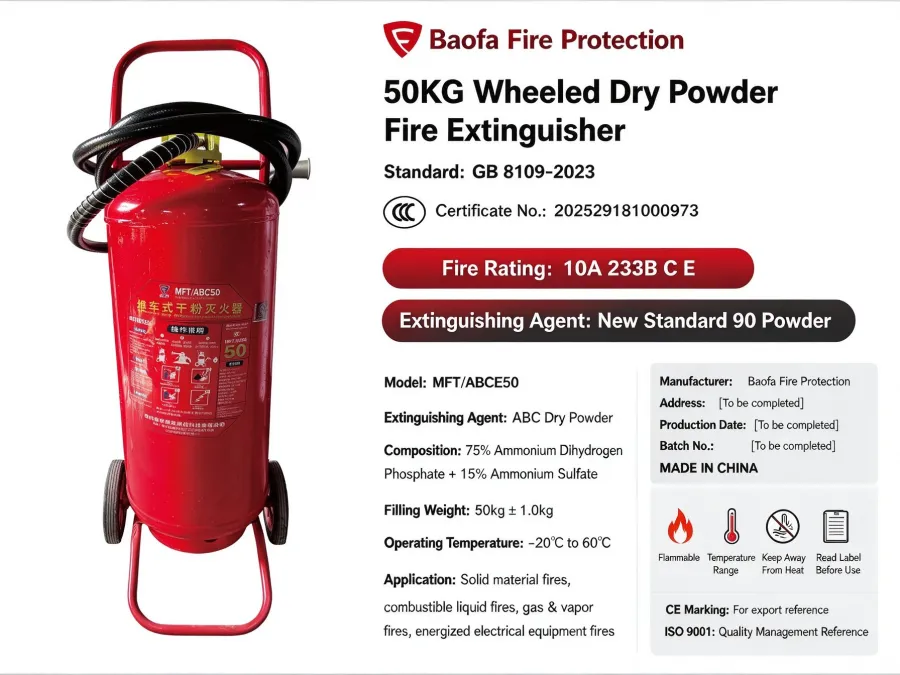
For buyers sourcing finished units or empty shells, cylinder specification is therefore the first thing to fix in a purchase order, before powder weight, bracket type or label design. The same logic applies whether you are ordering a 1 kg portable or a 50kg wheeled ABC dry powder fire extinguisher.
Deep-drawn low-carbon steel is the default for portable bodies in most EN3 designs. It draws well, welds reliably and accepts internal and external coatings. Welded steel is more common at larger capacities and for wheeled units.
Stainless bodies are specified for corrosive or marine environments and for buyers who want a longer service interval between external recoats. Cost is materially higher, and thread galling at the valve connection needs attention during assembly.
Aluminium is used in some lightweight and specialty designs. Composite and liner-based shells exist but are a minority in dry powder ABC product and require their own approval route.
Thickness is not a single number: it is a calculated value driven by diameter, design pressure, material yield strength and the applicable standard's safety factor. Buyers should specify the standard and the design pressure, not just a millimetre figure.
As a practical reference, the table below shows typical ranges. Actual values depend on specification, standard and manufacturer's design calculation.
| Parameter | Typical range | Notes |
|---|---|---|
| Body material | Deep-drawn or welded carbon steel; stainless option | Stainless for corrosive sites |
| Nominal wall thickness | 1.2–3.0 mm | Thicker at larger diameters |
| Design pressure | 12–18 bar (portable); higher for some wheeled designs | Confirm against the standard applied |
| Proof (hydrostatic) test | Typically ~1.5× design pressure | Held for a defined dwell time |
| Burst test | Typically ≥2.5× design pressure | Destructive, on samples |
| Valve thread | M30×1.5 and similar | Must match valve supplier |
| External finish | Powder coat or paint, 60–120 µm | Affects corrosion life |
| Service temperature | −20 °C to +60 °C | Verify for your market |
Portable bodies are usually deep-drawn from steel disc, then trimmed, necked and threaded. Wheeled bodies are more often rolled and longitudinally welded, with end domes attached by circumferential weld. Weld quality is verified by visual inspection and, depending on the standard, by sample sectioning or non-destructive checks.
After forming, shells are cleaned, internally coated where specified, and externally powder-coated or painted. Threads are protected during coating and inspected afterwards, because coating in the thread is a common cause of valve seating faults.
Two tests matter commercially. The hydrostatic proof test is applied to every shell (or to a defined batch sample, depending on the standard and the manufacturer's approved procedure) and confirms the shell holds pressure without permanent deformation. The burst test is destructive and is run on samples to confirm the design margin.
Ask for the test pressure, dwell time, acceptance criteria and how records are retained and linked to a batch or serial number. A certificate without traceability to your shipment is of limited value.
For empty shells and OEM components, vet the factory on process control rather than on catalogue claims. Ask which standards the design is calculated to, request a sample test report, and confirm that the same line will produce your repeat orders.
Commercial terms vary widely. MOQ for standard portable shells is commonly in the hundreds to low thousands per size; wheeled bodies are usually lower volume and higher unit value. Lead time typically runs several weeks from confirmed artwork and deposit, longer around peak season. Documentation should include the test record, material certificate, coating specification and packing list.
If you buy finished extinguishers rather than shells, the same questions apply one level down the supply chain. Review the full range on our products page and compare specifications before shortlisting sizes.
Small portables from 1 kg to 3 kg use thin, deep-drawn bodies where weight and cost dominate. Mid-range 4 kg to 8 kg units balance thickness against handleability. Wheeled units such as the 20kg wheeled model and larger 35 kg and 50 kg bodies use thicker walls, welded construction and heavier valve assemblies.
Whichever size you source, keep the cylinder specification, valve specification and test documentation as one package. Common buyer questions on testing and documentation are answered on our FAQ page.
In practice, cylinder quality is confirmed by three things: a stated design basis, a traceable pressure test, and a supplier who will show you both. Fix those in the purchase order and most downstream problems with valves, powder discharge and transport compliance disappear. Buyers comparing finished units should match cylinder specification to the capacity and duty cycle they actually need.
Most ABC dry powder bodies are deep-drawn or welded low-carbon steel. Stainless steel is specified for corrosive or marine environments, and aluminium appears in some lightweight designs. The material should be stated in the purchase order together with the design standard, because it determines the required wall thickness and test pressure.
Wall thickness typically falls between 1.2 mm and 3.0 mm, with larger diameters and higher design pressures at the upper end. Thickness is a calculated value derived from diameter, design pressure, material strength and the applicable standard's safety factor, so buyers should specify the standard rather than a single millimetre figure.
Portable ABC bodies are commonly designed for roughly 12–18 bar, with some wheeled designs higher. The hydrostatic proof test is typically about 1.5 times design pressure for a defined dwell time, and sample burst testing is typically at or above 2.5 times design pressure. Confirm exact values against the standard applied to your order.
It depends on the standard and the manufacturer's approved procedure. Some routes require every shell to be proof-tested; others permit batch sampling with defined acceptance criteria. Either way, ask how test records are linked to a batch or serial number so the certificate can be traced to your shipment.
Yes. Many assembly plants buy empty shells, valves, hoses and gauges separately. If you source components from different suppliers, confirm valve thread tolerance and gauge compatibility before volume production, since mismatched threads are a frequent cause of assembly faults and leaks.
Expect a pressure test record traceable to your batch or serial range, a material certificate, the coating specification and a packing list. Depending on your market you may also need declaration-of-conformity documents. A generic certificate without traceability to your order is of limited commercial value.
Stainless bodies resist external corrosion better than coated carbon steel, which can matter in coastal or humid sites and may reduce recoat frequency. It costs materially more, and thread galling at the valve connection needs attention during assembly. Specify it where exposure justifies the cost, not for appearance alone.
MOQ for standard portable shells is commonly in the hundreds to low thousands per size, while wheeled bodies are lower volume and higher unit value. Lead time typically runs several weeks from confirmed artwork and deposit, and extends around peak season. Confirm both in writing before committing to a delivery schedule.