For most fire extinguisher shipments from China, FOB is the practical default: the seller clears export and delivers to the named port, and the buyer controls freight and insurance from that point. CIF suits buyers who want one landed price to the destination port, and EXW shifts nearly all logistics to the buyer and is rarely the best choice for regulated goods such as pressurised extinguishers.
The right term depends on who can book freight more cheaply, who wants control of insurance, and how the destination country treats dangerous goods. The comparison below is general guidance; the binding definition is always the agreed contract and the current Incoterms rules.
Incoterms allocate cost, risk and tasks between seller and buyer. They do not set payment terms, product quality or certification obligations, which belong in the sales contract and technical annexes.
The seller makes goods available at its premises. The buyer handles export clearance, inland transport, main carriage, import clearance and insurance. Risk passes at the factory gate.
The seller delivers goods on board the vessel at the named Chinese port and clears export. Risk passes once goods are on board. The buyer arranges and pays main freight and insurance.
The seller pays cost and freight to the named destination port and arranges minimum-cover insurance. Risk still passes when goods are on board at origin, not at destination.
| Item | EXW | FOB | CIF |
|---|---|---|---|
| Export clearance | Buyer | Seller | Seller |
| Inland haulage to port | Buyer | Seller | Seller |
| Main ocean freight | Buyer | Buyer | Seller |
| Marine insurance | Buyer (optional) | Buyer (optional) | Seller, minimum cover |
| Risk transfer point | Seller's premises | On board at origin port | On board at origin port |
| Import clearance & duties | Buyer | Buyer | Buyer |
| Typical quote basis | Per unit, ex-factory | Per unit, named port | Per unit, destination port |
| Documentation burden | Mostly buyer | Shared | Mostly seller |
Note that CIF transfers risk at origin, not at destination. Buyers who assume the seller carries risk to the destination port until collection are misreading the term.
Dry powder extinguishers are pressurised articles and may be classified as dangerous goods depending on specification, cylinder pressure and the applicable regulations. Carriers and forwarders often require a transport document or declaration before booking.
Under EXW, the buyer must obtain export clearance and any dangerous goods documentation from a foreign factory, which is difficult without a local agent. Under FOB or CIF, the seller's freight contacts usually handle booking and paperwork more smoothly.
Portable units from 1kg to 8kg are typically carton-packed and palletised, while 20kg, 35kg and 50kg wheeled units need reinforced packing and different container planning. Volume and weight affect freight cost more than the Incoterm itself.
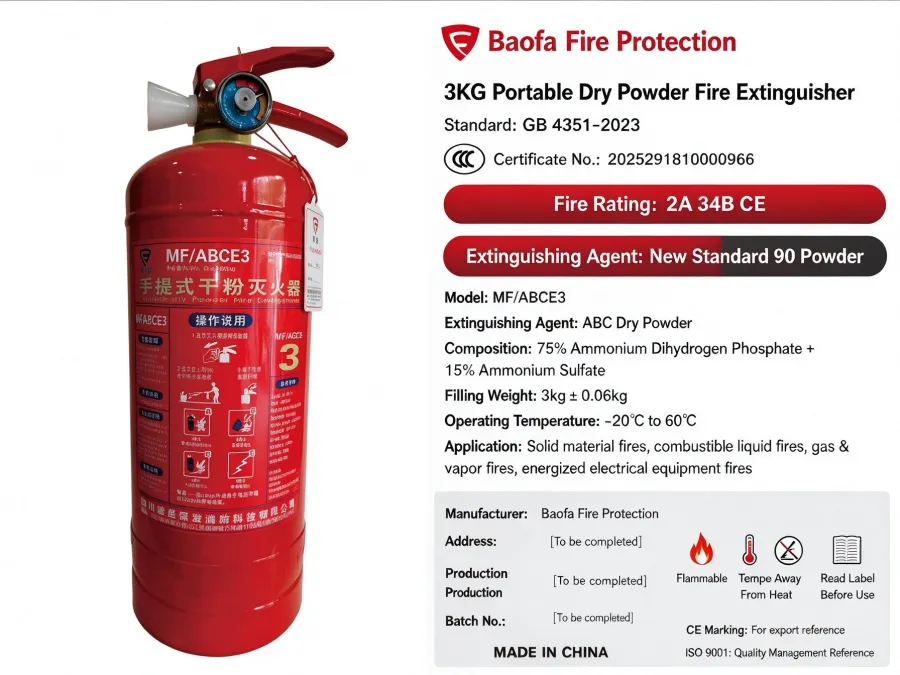
Because freight is a large share of landed cost on bulky wheeled models, many buyers prefer FOB so they can compare forwarder rates directly. See the 3kg ABC dry powder fire extinguisher as a reference for typical portable carton dimensions.
Whichever term applies, confirm in writing which party provides each document. Ambiguity here causes more disputes than price.
For document-related buyer questions, the FAQ page covers common paperwork and shipping points.
Distributors with established forwarders usually get better rates on FOB and keep control of routing and insurance. Importers new to Chinese sourcing often prefer CIF for a single predictable price to port.
OEM assembly plants buying cylinders, valves and empty components may find FOB workable because components are less regulated than charged extinguishers. Finished, charged units need more careful handling of documentation regardless of term.
EXW can suit buyers with a Chinese consolidation agent who already manages export clearance and mixed loads. Without that infrastructure, EXW tends to create delays at the factory gate.
Confirm that the supplier can actually perform the term offered. A factory quoting CIF should be able to name its forwarder, show prior shipments and explain how it handles dangerous goods documentation.
Ask for the Incoterm in writing on every quotation, together with the named port, MOQ and lead time. Typical MOQ and lead times vary by model and specification; confirm per order rather than relying on general figures.
Review the supplier's product range and documentation package before committing. The products overview shows the portable and wheeled lines and component categories available for quotation.
FOB is the most common and balanced term for extinguisher shipments: the seller clears export and loads on board, and the buyer controls freight and insurance. CIF simplifies budgeting to the destination port but transfers risk at origin, while EXW is best reserved for buyers with a local agent. Agree the term, named port and document responsibilities in writing before the order is placed.
FOB is the most common choice for most importers. It gives the seller responsibility for export clearance and loading, while the buyer controls freight and insurance. CIF suits buyers who want one price to the destination port, and EXW is generally only practical when the buyer has a Chinese agent handling export clearance.
Under CIF, risk passes when the goods are on board the vessel at the origin port, not at the destination port. The seller pays freight and arranges minimum-cover insurance, but the buyer bears risk during the ocean voyage. Buyers wanting broader protection should arrange their own additional insurance.
It is possible but usually impractical. Under EXW the buyer handles export clearance and any dangerous goods documentation, which requires a local agent familiar with Chinese export procedures. Most buyers of charged extinguishers prefer FOB so the seller manages export formalities.
The Incoterm changes what is included in the quoted price, not the ex-factory unit price itself. FOB and CIF quotes include inland costs and, for CIF, freight and insurance. MOQ is set by production and packing considerations and is usually quoted separately from the shipping term.
List the commercial invoice, packing list, bill of lading, certificate of origin where required, and any dangerous goods declaration or transport statement. Under CIF, add the insurance certificate. Also specify which product certificates and test reports the seller must provide with the shipment.
CIF requires only minimum cover under the standard institute clauses. That may not match the cargo value or the risks on a long route. Buyers should review the insured percentage and clauses, and purchase supplementary cover where the shipment value or handling risk justifies it.
Confirm each quote names the same origin port, the same product specification and the same packing. Differences in carton quantity, palletisation or included accessories can make FOB prices look different when the underlying offer is not comparable. Request a written breakdown per model.
The term itself does not change, but freight cost and packing do. Wheeled 20kg, 35kg and 50kg units are bulky and heavier, so FOB is often preferred to keep control of freight rates. Confirm pallet dimensions and container loading before booking.