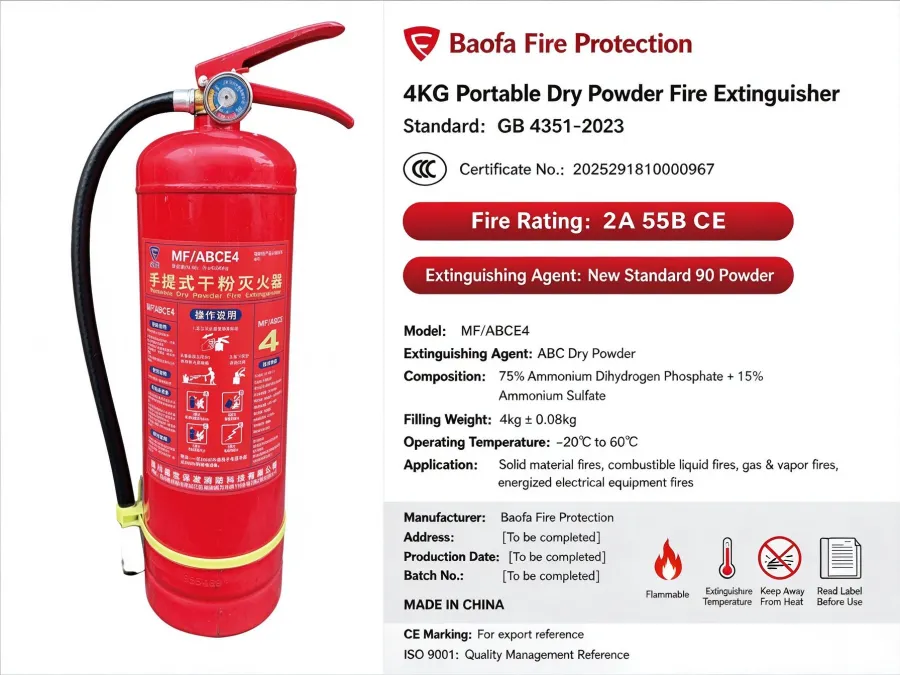
Pressure gauge selection for dry powder extinguishers comes down to four variables: the correct pressure range for the stored pressure, the thread and valve interface, the dial diameter and readability, and the documentation that proves the gauge suits the cylinder. For a standard portable ABC unit such as the 4kg ABC dry powder fire extinguisher, the gauge is a small but inspection-critical part, and mismatches are a common cause of rejection at filling or annual service. This guide sets out what importers, distributors and assembly plants should specify before ordering.
The gauge is a pressure indicator, not a pressure-control device. It shows whether the stored pressure inside the cylinder sits within the operating band, so a service technician or end user can confirm the extinguisher is ready for use without weighing it.
In most EN3-type designs the gauge is fitted to the valve head and connects to the cylinder interior through a small passage. The gauge therefore has to match both the valve thread and the pressure band the valve and cylinder were designed for.
Gauges are usually supplied as a separate component in OEM parts orders, which means the buyer, not the extinguisher assembler, often decides the specification. That makes it worth writing the requirement down rather than leaving it to the supplier.
Portable dry powder extinguishers are typically pressurised with dry nitrogen to a working pressure that depends on the design and the applicable standard. Gauges are commonly offered in bands such as 0–16 bar, 0–25 bar and 0–35 bar, with a green sector marking the acceptable operating zone.
The gauge range must be high enough to survive the cylinder's test pressure without damage, and low enough that normal operating pressure sits comfortably inside the dial rather than near the top. A gauge whose green sector does not align with the valve's intended charge pressure is a specification error, even if the thread fits.
Dial faces are usually colour-zoned (red/green/red or red/yellow/green depending on the market). Confirm the colour convention and any language or unit requirements for the destination market, since these vary between regions.
Gauge threads are commonly M10×1, M10×1.25 or 1/8 BSP variants, and the sealing method may be an O-ring, a bonded seal or a tapered thread with sealant. The gauge must match the valve head, not the other way round.
If you buy valves and gauges from different suppliers, request thread drawings from both and compare pitch, diameter and sealing face before placing volume orders. A sample fit test on a handful of valve bodies is cheaper than a container of unusable parts.
Where the gauge sits inside a protective valve guard or cap, check the dial diameter and body height clear the guard. Gauges of nominally the same range can differ by several millimetres in body length.
The table below gives indicative ranges only. Final values must follow the valve design, the cylinder test pressure and the standard the finished extinguisher is declared against.
| Parameter | Typical range | Notes |
|---|---|---|
| Dial diameter | 20–28 mm | Larger dials improve readability; check guard clearance |
| Pressure range | 0–16 bar to 0–35 bar | Must exceed cylinder test pressure without damage |
| Accuracy class | ±2.5% to ±4% of full scale | Confirm against buyer or standard requirement |
| Thread | M10×1, M10×1.25, 1/8 BSP | Must match valve head |
| Body material | Brass or nickel-plated brass | Plating affects corrosion resistance |
| Window | Polycarbonate or glass | Impact and UV resistance vary |
| Operating temperature | −20 °C to +60 °C | Confirm for destination climate |
| Burst pressure | Typically 2–3× maximum dial value | Supplier declaration required |
Most gauge problems trace back to assumptions made at quotation stage rather than manufacturing defects. The pairs below cover the recurring ones.
Gauge suppliers range from specialist instrument makers to general extinguisher-parts traders. Ask for the manufacturer's own specification sheet, a thread drawing and a sample batch for fit testing. Where the supplier cannot provide a written pressure and burst declaration, treat the part as unverified.
MOQ for gauges is usually set in hundreds or thousands of pieces and is often lower when ordered alongside valves or complete extinguishers. Lead times typically run a few weeks for stock ranges and longer for custom dial printing; confirm both against your assembly schedule.
Documentation should include a packing list with part numbers, a pressure/burst declaration and, where applicable, material or plating certificates. If the finished extinguisher is to be declared against a standard, keep gauge documentation in the technical file. Buyers assembling complete units can cross-check component lists against the finished models on the products page, and general purchasing questions are covered in the FAQ.
Specify the gauge by thread, pressure range, green-sector position, dial size and documentation, not by range alone. Run a sample fit test on production valve bodies before releasing a volume order. Treated this way, the gauge becomes a low-risk, easily repeatable component rather than a recurring inspection issue.
It depends on the valve and cylinder design. Portable ABC units commonly use gauges in the 0–16 bar to 0–35 bar range, with a green sector marking the charge pressure. The gauge must tolerate the cylinder test pressure without damage, so confirm the range against the valve specification rather than copying another model.
No. M10 threads are available in different pitches, commonly 1.0 mm and 1.25 mm, and sealing methods differ between O-ring, bonded seal and tapered designs. Always compare thread drawings from the valve and gauge suppliers, and fit a sample before ordering in volume.
In practice, yes. The gauge must match the valve head's thread, sealing face and internal passage, and should clear any guard or cap. Mixing brands is possible where specifications align, but keeping one gauge part number per valve model simplifies servicing and spare-parts stocking.
Most portable dry powder extinguishers use gauges with dial diameters of roughly 20–28 mm. Larger dials are easier to read but may not fit inside the valve guard. Check body length as well as diameter, since gauges of the same range can vary in height.
Ask for a specification sheet covering range, accuracy class, thread and materials, plus a written pressure and burst declaration. A packing list with part numbers and, where relevant, plating or material certificates should accompany each shipment. Keep these in the technical file for the finished extinguisher.
Yes. Gauges are commonly supplied as standalone OEM components, and MOQs are usually lower when ordered alongside valves or complete extinguishers. Lead times are typically a few weeks for standard ranges and longer where custom dial printing or marking is required.
A practical check includes verifying the part number and thread, confirming the green sector position against the valve specification, checking dial condition and window clarity, and pressure-testing a sample of assembled valves for leaks. Record the results against the purchase order.
They can. Some markets use red/green/red zoning, others red/yellow/green, and dial language and units (bar or psi) also vary. Confirm the convention required for the destination market and have the supplier show the dial face on a sample before production.