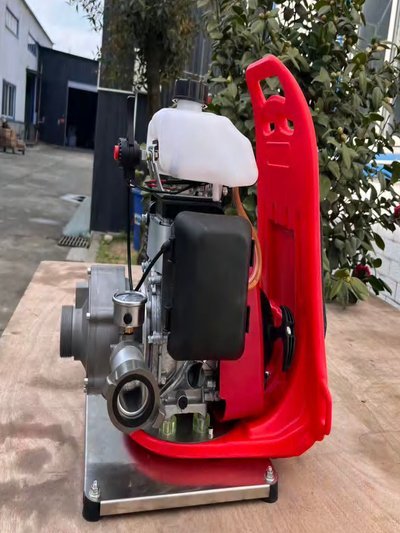
I. Product Introduction and Application Scenarios
The high-pressure water mist fire extinguisher is a portable device that uses a high-pressure pump to convert water into micron-sized mist droplets for firefighting, combining cooling, smothering, and isolation effects. Its core advantages lie in low water consumption, high firefighting efficiency, and minimal water damage, making it especially suitable for extinguishing initial forest fires and cleaning up residual embers.
Suitable Working Conditions
- Rapid suppression of initial forest fires and surface fires
- Mountainous steep slopes and areas difficult for personnel to reach quickly
- Standard individual equipment for emergency supply reserve warehouses
- Used in conjunction with the LSA-J527 High-Pressure Relay Fire Pump (Five-Stage Pump) to achieve "pump + unit" relay firefighting
- Forest patrol and firebreak belt humidification
Unsuitable Working Conditions
- Large-area crown fires and frontal assault on high-intensity fire lines
- Water sources beyond the equipment's maximum head with no relay pump support
- Non-fire emergency rescue such as mudslides and floods
- Extended continuous operation exceeding the equipment's heat dissipation limit
II. Core Technical Parameters and Configuration Standards
| Parameter | Typical Range | Description |
| Working Pressure | 4~8 MPa | Higher pressure produces finer atomization |
| Head | 30~80 m | Vertical water delivery height |
| Flow Rate | 20~40 L/min | Water consumption in atomized state |
| Mist Droplet Size | 50~200 μm | Finer droplets yield higher firefighting efficiency |
| Total Weight | 8~15 kg | Including battery or fuel tank |
| Runtime | 20~45 min | Depends on power type |
| Water Tank Capacity | 10~20 L | External water source connectable |
III. Procurement Pain Points
- Geographic and climatic differences: Local mountainous areas have high altitude and large temperature variations; equipment must adapt to cold-start conditions and high-altitude power degradation.
- Complex terrain: Local steep slopes and dense forests mean that carried weight and mobility directly affect combat effectiveness.
- Limited equipment budget: Emergency supply reserves need to balance quantity and quality, avoiding the situation of "affordable to buy but unaffordable to use."
- Strict qualification acceptance: Government and enterprise procurement requires a full set of documents including test reports, certificates of conformity, and after-sales commitments.
- Emergency interoperability requirements: Equipment must be compatible with existing pumps, hoses, and couplings to form a firefighting system.
IV. Common Misconceptions in Selection and Procurement
- ❌ Looking only at head without considering flow rate, resulting in poor atomization and low firefighting efficiency. ✅ Head and flow rate must match; prioritize models with stable pressure and uniform atomization.
- ❌ Blindly pursuing lightweight design while ignoring structural strength and durability. ✅ Find a balance between weight and reliability; prioritize aviation aluminum and stainless steel pump heads.
- ❌ Neglecting battery/fuel runtime, causing frequent interruptions in actual operations. ✅ Choose runtime based on the local maximum single firefighting duration, and equip spare power sources.
- ❌ Not testing coupling compatibility, resulting in inability to connect to existing hoses upon delivery. ✅ Confirm interface standards before procurement; prioritize universal camlock couplings.
- ❌ Underestimating after-sales training, leading to malfunctions from improper operation. ✅ Choose manufacturers that provide on-site training and video guidance.
- ❌ Comparing only prices without comparing qualifications, resulting in missing key documents during acceptance. ✅ Require manufacturers to provide test reports, 3C certification, and warranty certificates.
V. Criteria for Screening Reliable Manufacturers
- Complete qualifications: Possess firefighting equipment production/sales qualifications, with products passing national firefighting testing.
- Solid craftsmanship: Key components such as pump heads, valve bodies, and spray guns use corrosion-resistant materials with high assembly precision.
- Test reports: Provide third-party test reports with verifiable and authentic parameters.
- After-sales network: Have service points locally or nearby, with response time not exceeding 24 hours.
- Sufficient inventory: Commonly used models in stock to shorten emergency procurement cycles.
- Controllable lead time: Clear delivery times for customized or bulk orders to avoid delays during fire prevention periods.
- Compliance: Products comply with national forest firefighting equipment standards and can participate in government and enterprise bidding.
VI. Real Project Case
A forest ranger station procured a batch of high-pressure water mist fire extinguishers in 2025 for emergency supply reserves. The forest farm is at an altitude of approximately 1,200 meters with slopes of 25°~40°, and the primary risk is initial surface fires. Configuration plan: 10 high-pressure water mist fire extinguishers, 2 supporting LSA-J527 High-Pressure Relay Fire Pumps (Five-Stage Pumps), and 500 meters of fire hose. In field tests, a single operator carrying the extinguisher suppressed a 20-meter fire line within 10 minutes, and with the relay pump, water could be delivered to a fire scene 300 meters away. Rangers reported that the equipment starts quickly, atomizes well, and is comfortable to carry, significantly improving initial fire response capability.
Summary
The core of selecting a high-pressure water mist fire extinguisher is balancing head, atomization, and carrying comfort. Ranger stations should consider local terrain, water sources, and budget, prioritizing manufacturers with complete qualifications and comprehensive after-sales support. Longsheng'an Firefighting provides a full range of forest firefighting equipment and bidding support. Consultation hotline: 13060031111.