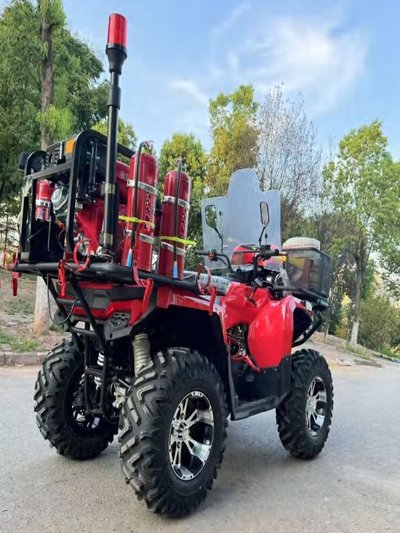
Fire motorcycles are key mobile equipment for achieving "early detection, early suppression, and early extinguishment" in mountainous forest areas. They are mainly used for rapidly transporting firefighting personnel, portable water pumps, fire hoses, and initial firefighting water. By structure, they are divided into two-wheel fire motorcycles and four-wheel fire motorcycles; by function, they are divided into personnel transport type, water transport type, and comprehensive type. Suitable working conditions: mountain steep slopes, gravel roads, and forest trails with patrol road widths of 1.5 meters or more in forest areas; scenarios requiring rapid deployment of 3-6 person crews carrying 200-500 liters of water or fine water mist fire extinguishing machines; emergency material reserve warehouses serving as first-response forces. Unsuitable working conditions: trackless virgin forest areas, swampy wetlands, and continuous stair-step terrain; scenarios requiring sustained water transport over long distances (exceeding 20 kilometers), where high-pressure relay fire pumps and water storage tank solutions should be used instead.
| Parameter Item | Two-Wheel Fire Motorcycle | Four-Wheel Fire Motorcycle |
| Personnel Capacity | 1-2 persons | 2-4 persons |
| Water Capacity | 50-120 L | 200-500 L |
| Climbing Ability | 15-25 degrees | 20-35 degrees |
| Range | 60-120 km | 80-150 km |
| Pump Head | Optional 30-80 m | Optional 50-120 m |
| Firefighting Equipment | Fine water mist extinguisher, wind extinguisher | High-pressure fine water mist, portable pump, LSA-LDJ84 lithium-electric chain saw |
Configuration standard recommendations: Prioritize four-wheel models with differential locks, off-road tires, and roll cages; water tanks must be corrosion-resistant with quick-connect fittings; electrical system waterproof rating not lower than IP54; onboard tools should include a gasoline chain saw or lithium-electric chain saw, fire hoses, and water dividers.
Local procurement often faces the following pain points: First, significant geographical and climatic differences, with high-temperature and high-humidity or severe cold regions having notable impacts on battery and rubber component lifespan; second, complex terrain, where ordinary two-wheel motorcycles have insufficient passability on steep muddy roads; third, limited equipment budgets, requiring trade-offs between personnel transport and water transport; fourth, strict qualification acceptance requirements, where vehicles need fire product certification or MIIT announcement; fifth, emergency linkage requiring rapid response, with spare parts inventory and after-sales service outlets needing to be covered nearby.
When screening manufacturers, attention should be paid to: whether qualifications are complete (fire product certification, ISO system, announcement catalog); whether workmanship is solid (frame welding, water tank anti-corrosion, wiring harness waterproofing); whether testing is comprehensive (climbing, braking, range, pump performance); whether after-sales service is nearby (parts warehouses, response time, warranty years); whether inventory is sufficient (common models and consumable parts); whether delivery time is controllable (emergency procurement requires clear delivery cycles); whether compliance meets local acceptance requirements. It is recommended to conduct on-site test drives and verify project cases of the same model.
A forest farm protection station in a certain area is equipped with 2 four-wheel fire motorcycles and 4 two-wheel fire motorcycles for emergency material reserves. The working conditions are mountain steep slopes and forest trails, with a water source distance of approximately 3 kilometers. Configuration plan: Four-wheel vehicles carry 300 L water tanks and high-pressure fine water mist extinguishing machines; two-wheel vehicles transport team members, portable water pumps, and fire hoses. Results achieved: Initial fire response time shortened to within 8 minutes; a single water transport run can suppress 50-80 meters of initial fire line; combined with relay pumps to achieve continuous water supply. The station also reserves LSA-LDJ84 lithium-electric chain saws for opening isolation belts, with feedback that the chain is sharp and maintenance is simple.
Fire motorcycles undertake the dual tasks of mobile personnel transport and water transport in mountain firefighting. The core of selection is terrain passability, water capacity matching, and after-sales support. It is recommended to organize by "two-wheel for personnel transport + four-wheel for water transport" and equip with high-pressure relay pumps and fine water mist extinguishing machines. For information about supporting equipment such as the LSA-LDJ84 lithium-electric chain saw, please consult Longsheng'an Firefighting at 13060031111 for selection and bidding support.