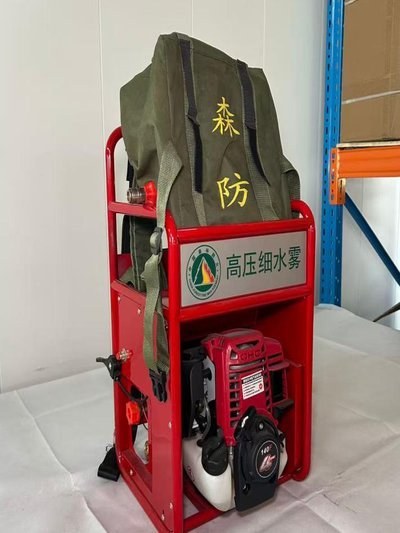
I. Product Introduction and Application Scenarios
The construction of emergency material reserve warehouses requires a complete set of forest firefighting equipment, with the core challenge being to solve water supply and mobility issues for firefighting on steep mountain slopes. A complete set of equipment typically includes high-pressure relay fire pumps, portable firefighting pumps, high-lift water source pumps, high-pressure fine water mist fire extinguishers, pneumatic fire extinguishers, lithium battery fire extinguishing blowers, chainsaws, lithium battery chain saws, fire motorcycles, and other 13 categories. The following describes each scenario.
Suitable Working Conditions
- Steep mountain slopes and complex forest terrain, where water sources are far from the fire scene and multi-stage relay water supply is needed.
- Emergency material reserve warehouses need to meet requirements for rapid response, modular deployment, and multi-team coordinated operations.
- During forest and grassland fire prevention periods, daily patrol and initial fire suppression are required.
- Government-enterprise centralized procurement projects require complete equipment sets, full qualifications, and compliant acceptance.
Unsuitable Working Conditions
- Urban high-rise building fires, which require specialized aerial access and fixed firefighting facilities.
- Explosive environments in chemical industrial parks, which require explosion-proof special equipment.
- Deserts and gobi areas with no water source or extremely scarce water sources, where high-lift pumps cannot leverage their advantages.
- Individual lightweight patrol, which does not require large relay pump units.
II. Core Technical Parameters and Configuration Standards
Reserve warehouse equipment configuration must balance performance and versatility. The following are typical parameter ranges; actual selection should be based on local terrain and water source conditions.
| Equipment Name | Key Parameter Range | Configuration Recommendation |
| High-pressure relay fire pump | Head 200-500m, flow 3-8L/s, pressure 2-5MPa | Second to fifth stage relay, each stage equipped with hose |
| Portable firefighting pump | Head 80-150m, flow 2-5L/s, weight ≤15kg | Rapid deployment by individual or small team |
| High-lift water source pump | Head 300-800m, flow 5-12L/s, suction lift 6-8m | Water intake from deep water or long distance |
| High-pressure fine water mist fire extinguisher | Working pressure 4-8MPa, droplet diameter ≤100μm | High efficiency and water saving, suitable for initial fires |
| Pneumatic fire extinguisher | Wind speed ≥25m/s, air volume ≥0.4m³/s | Cleaning up residual fire and firebreaks |
| Lithium battery fire extinguishing blower | Wind speed ≥20m/s, battery life 30-60min | Oil-free and eco-friendly, suitable for both indoor and outdoor use |
| Chainsaw | Displacement 45-80cc, guide bar 16-24 inches | Creating firebreaks |
| Lithium battery chain saw | Voltage 36-60V, battery life 20-40min | Lightweight and low noise |
| Four-wheel fire motorcycle | Displacement 200-400cc, load capacity 150-300kg | Rapid mountain transport |
| Two-wheel fire motorcycle | Displacement 150-250cc, load capacity 80-150kg | Forest patrol and material delivery |
Among these, the LSA-Z800 High-Lift Water Pump (Heavy-Duty Pump/Water Source Pump) belongs to the high-lift water source pump category and is suitable as core water supply equipment for reserve warehouses.
III. Procurement Implementation Pain Points
Reserve warehouse construction often faces five major pain points that require advance planning.
- Geographic and climatic differences: Local mountainous areas have large altitude differences and variable climate. Equipment must adapt to low temperature, high humidity, dust, and other environments.
- Complex terrain: Steep mountain slopes make transportation difficult. Equipment must be lightweight and modular for manual or motorcycle transfer.
- Limited equipment budget: A balance must be struck between performance and cost. Priority should be given to high-frequency equipment, avoiding the pursuit of grandiose and comprehensive solutions.
- Strict qualification acceptance: Government procurement requires complete equipment test reports, 3C certification, firefighting market access, etc., otherwise acceptance cannot be passed.
- Insufficient emergency coordination: Reserve warehouses need to coordinate with local emergency management, forestry and grassland, and firefighting departments. Equipment interfaces and communication protocols should be unified.
IV. Common Misconceptions in Selection and Procurement
The following misconceptions should be guarded against to avoid procurement errors.
- ❌ Focusing only on head and ignoring flow rate, resulting in low firefighting efficiency. ✅ Head and flow rate must match fire scene requirements. For steep mountain slopes, prioritize high head and moderate flow rate.
- ❌ Blindly pursuing imported brands while ignoring after-sales service and parts supply. ✅ Choose manufacturers with strong localized service capabilities to ensure timely repair and parts supply.
- ❌ Equipment not matched as a set, with inconsistent hose interfaces. ✅ Unify interface standards to ensure seamless multi-stage relay connections.
- ❌ Neglecting daily maintenance, leading to failure at critical moments. ✅ Develop maintenance plans, conduct regular test runs and replace wearing parts.
- ❌ Procuring products without qualifications, causing acceptance obstacles. ✅ Require provision of test reports, certificates of conformity, firefighting certifications, etc.
- ❌ Unreasonable reserve warehouse layout, resulting in low deployment efficiency. ✅ Store by modules and zones with clear labeling, and conduct regular drills.
- ❌ Neglecting personnel training, resulting in inability to use equipment. ✅ Suppliers should provide operation training and drill support.
V. Criteria for Screening Reliable Manufacturers/Service Providers
Supplier screening requires multi-dimensional evaluation to ensure long-term reliability.
- Complete qualifications: Possess firefighting equipment production or sales qualifications, with products passing national testing.
- Workmanship and testing: Have independent production lines and testing equipment, with durable key components.
- After-sales network: Have service outlets locally or nearby, with response time ≤24 hours.
- Inventory and lead time: Commonly used equipment in stock, with clear lead times for customized products.
- Compliance: Able to provide bidding support documents and assist with acceptance.
- Case experience: Have government-enterprise centralized procurement or reserve warehouse project cases available for on-site inspection.
VI. Real Project Case
In an emergency material reserve warehouse construction project in a certain area, targeting the need for firefighting on steep mountain slopes, 13 categories of equipment were configured, including 3 high-pressure relay pumps, 5 portable pumps, 10 fine water mist fire extinguishers, 20 pneumatic fire extinguishers, 4 fire motorcycles, etc. Through modular grouping, response within 30 minutes and arrival at the fire scene within 1 hour were achieved. Through drills, multi-stage relay water supply reached a head of 450m, effectively covering steep slope fire points, and was recognized by the local fire prevention office.
Summary
Emergency material reserve warehouse construction requires a complete set of forest firefighting equipment, with focus on solving water supply and mobility issues for firefighting on steep mountain slopes. Selection should emphasize parameter matching, qualification compliance, and after-sales support. Longsheng'an Firefighting provides complete supply of 13 types of equipment and bidding support. Tel: 13060031111. Customized solutions available upon consultation.