Wheeled ABC dry powder extinguishers in 20kg, 35kg and 50kg sizes differ from portable units mainly in three areas: the chassis or trolley that carries the cylinder, the hose and nozzle assembly that delivers the powder, and the recharge and service points that determine maintenance cost over the unit's life. Buyers specifying these units for export should confirm all three against the destination market's requirements, because a well-built cylinder on a weak chassis, or with a hose that cannot be replaced locally, becomes a support problem after delivery.
Capacity drives almost every other decision. A 20kg unit is typically a single-cylinder trolley that one person can move on firm ground, while 35kg and 50kg units generally use larger wheels, a longer hose and a more heavily braced frame. Weight, centre of gravity and wheel diameter all change with capacity, so a chassis design that works at 20kg is not automatically suitable at 50kg.
Discharge performance also scales. Larger units usually carry a longer hose and a larger-bore nozzle so the operator can stand further back and still achieve an effective powder stream. The exact throw and discharge time depend on the valve, hose bore and powder specification, and should be confirmed from the manufacturer's data rather than assumed.
| Parameter | 20kg | 35kg | 50kg |
|---|---|---|---|
| Nominal powder charge | 20kg | 35kg | 50kg |
| Typical hose length | approx. 4–6m | approx. 5–8m | approx. 5–8m |
| Wheel diameter (typical) | approx. 250–300mm | approx. 300–400mm | approx. 350–450mm |
| Chassis material | painted steel, sometimes galvanised | painted or galvanised steel | galvanised or heavy-gauge steel |
| Working pressure (typical) | approx. 12–15 bar | approx. 12–15 bar | approx. 12–15 bar |
| Propellant | stored pressure or cartridge | stored pressure or cartridge | stored pressure or cartridge |
| Test pressure (order-specific) | per standard | per standard | per standard |
Values above are indicative ranges only. Final figures depend on the standard applied, the valve design and the buyer's specification.
The chassis carries the full loaded weight and takes the shock of being wheeled over kerbs, ramps and rough ground. Look at tube thickness, weld quality and whether the frame is painted, powder-coated or galvanised. Galvanised or powder-coated frames generally hold up better in humid or coastal storage, which matters for buyers in tropical markets.
Wheels are the most common failure point. Pneumatic tyres cushion better on uneven ground but puncture; solid rubber wheels are heavier and less forgiving but need less maintenance. Confirm axle diameter, wheel bearing type and whether spare wheels are available as a separate line item.
The hose on a wheeled unit is longer and larger-bore than on a portable extinguisher, and it is a service part that will eventually be replaced. Buyers should confirm the hose bore, length, burst pressure rating and end fittings, and whether replacement hoses are available as a separate SKU. A hose with non-standard threads locks the end user into one supplier.
Nozzles are usually a fixed or adjustable cone type. Confirm the material (typically plastic, brass or aluminium), the discharge pattern and whether a nozzle cap or plug is fitted to keep moisture out during storage. The valve or head assembly should allow straightforward pressure checking and powder refilling; cartridge-operated designs add a CO₂ cartridge that must be sourced locally.
Every wheeled extinguisher will eventually need recharging, and the recharge path should be agreed before the order ships. Stored-pressure units are refilled through the valve after depressurising; cartridge units are recharged by replacing the cartridge and refilling the powder. Both approaches require the correct powder grade and the right filling equipment.
Ask the supplier which spare parts are recommended for a service kit: valve seals, hose assemblies, nozzles, safety pins, pressure gauges and cartridges where applicable. Buyers distributing in markets with limited service infrastructure should consider ordering these kits alongside the extinguishers, since a unit that cannot be recharged locally is effectively single-use.
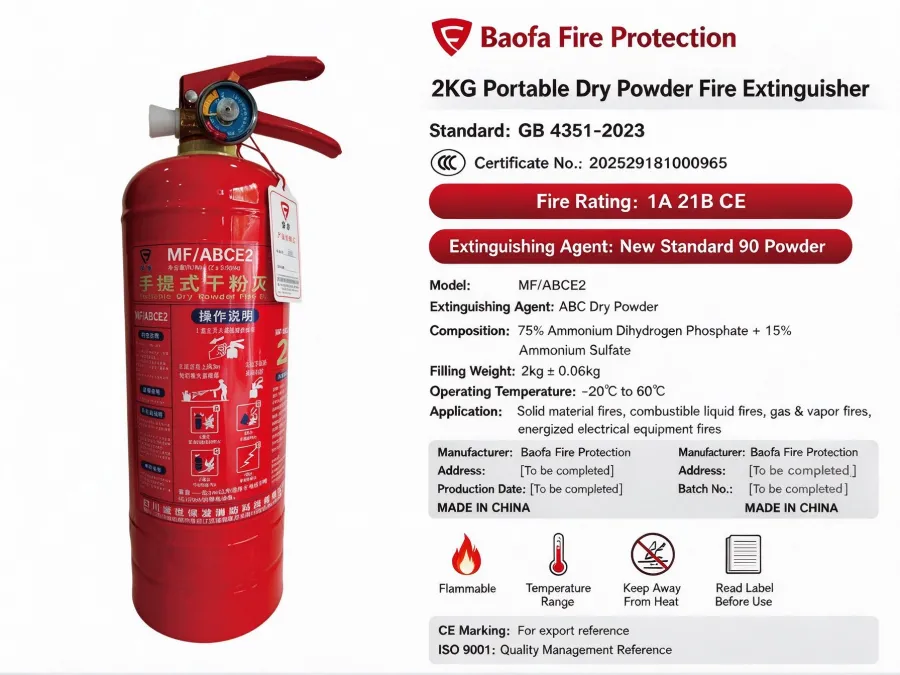
For buyers who also stock portable sizes, the same component logic applies across the range; see the 2kg ABC dry powder fire extinguisher as a reference point for valve, gauge and hose fittings used on smaller units.
When vetting a supplier for wheeled extinguishers, request the chassis drawing, hose specification and valve data sheet, not just a finished-product photo. Ask which standard the unit is built to and which test reports accompany each batch. Documentation should typically include a certificate of conformity, pressure test records for the cylinder and, where applicable, third-party inspection reports.
MOQ is usually quoted per capacity and per model, and mixed containers combining 20kg, 35kg and 50kg units with portable sizes are common. Lead time depends on whether cylinders and chassis are held in stock; custom frame colours or branding add time. Confirm packaging, pallet configuration and whether units ship fully assembled or partly knocked down.
Compare the full range of finished units on the products page, and review common buyer questions on the FAQ page before finalising a specification.
Wheeled 20kg, 35kg and 50kg extinguishers should be specified as a system: chassis rated for the loaded weight, hose and nozzle that can be replaced locally, and a recharge path supported by spare parts. Confirm these three points with the supplier in writing before ordering, and include service kits in the initial shipment where local support is limited.
Stored-pressure units hold the propellant gas in the cylinder with the powder and are recharged by refilling powder and repressurising. Cartridge-operated units use a separate CO₂ cartridge that is replaced at recharge. Cartridge designs can simplify refilling in some workshops, but require a local cartridge supply, so availability should be confirmed before purchase.
Loaded weight is substantially higher than the nominal powder charge once the cylinder, chassis and fittings are included. Most 50kg units are designed for one-person wheeling on firm, level ground but two-person handling for stairs or ramps. Buyers should request the loaded weight and confirm it against the site's manual-handling policy.
Hose length typically ranges from about 4–6m on 20kg units and 5–8m on 35kg and 50kg units, depending on design. Longer hoses allow the operator to stand further from the fire but can reduce discharge pressure. Specify length against the intended application and confirm the hose bore and burst rating with the supplier.
Reputable suppliers can usually provide wheels, axles, straps and frame components as separate line items. Availability varies by model, so confirm which parts are stocked and which are made to order. Ordering a small spares quantity with the initial shipment is a practical way to cover early warranty and service needs.
Recharge intervals depend on the destination market's regulations and on whether the unit has been discharged, partially used or found with low pressure during inspection. Many markets require periodic service checks at fixed intervals. Buyers should confirm local requirements rather than rely on a single global rule.
Yes, mixed containers combining 20kg, 35kg and 50kg wheeled units with portable sizes are common. Loading efficiency depends on pallet dimensions and whether units ship assembled. Provide the supplier with the full mixed order early so packaging and container planning can be done together.
Typical documentation includes a certificate of conformity, cylinder pressure test records, packing list and commercial invoice, plus any third-party inspection reports required by the buyer or destination authority. Requirements vary by market, so specify the document set in the purchase order to avoid delays at import.
Both typically use ABC dry powder, but the grade and specification should match the valve and nozzle design and the standard applied. Buyers sourcing powder separately should confirm compatibility with the supplier, especially where local refilling is planned after import.