The safety pin and tamper seal are the lowest-cost components on an extinguisher and the most frequent cause of a failed inspection. A missing pin, a bent pin, a broken seal or a seal that cannot be visually verified is an immediate defect in most inspection regimes, regardless of cylinder condition. For importers and assembly plants, specifying these parts correctly is a cheap way to protect pass rates across a whole consignment.
Inspectors follow a fixed sequence: access, readability, pressure, then tamper evidence. The pin and seal are checked before the gauge reading is trusted, because a broken seal means the extinguisher may have been operated or partially discharged. A unit that fails this step is usually removed from service pending recharging, even if the powder and pressure are intact.
Because the parts are small and loose-packed, they are also the most common shortage item at installation sites. Buyers who ship extinguishers without spare pins and seals typically receive replacement requests within the first service cycle. Including a small spares allowance per carton is a practical countermeasure.
The pin passes through the valve lever or head assembly to block accidental actuation. In most EN3 designs it is a steel or stainless-steel ring pin, typically 3–5 mm in diameter, with a pull ring sized for gloved operation. Length depends on the valve body and lever geometry, so pins are not interchangeable between valve families.
The seal ties the pin to the valve or handle so that any removal is visible. Common formats are a plastic breakaway tie, a wire-and-lead seal, or a plastic-bodied seal with a metal insert. Seals are usually colour-coded and carry a batch or date marking, depending on specification.
The table below shows ranges commonly seen in export orders. Exact values depend on the valve design, the standard being applied and the buyer's own inspection protocol.
| Parameter | Typical range | Notes |
|---|---|---|
| Pin diameter | 3–5 mm | Matched to valve lever hole |
| Pin material | Zinc-plated steel / stainless steel | Stainless preferred for humid markets |
| Pull ring diameter | 25–40 mm | Larger rings suit gloved use |
| Seal length | 80–150 mm | Depends on valve and bracket layout |
| Seal tensile strength | Low breakaway, hand-tearable | Must break without tools |
| Seal marking | Plain / batch code / date | Buyer-specified |
| Spares allowance | 1–3 % of order quantity | Common in export contracts |
Use a short, repeatable check at goods-in rather than relying on supplier statements. The list below covers the points that most often trigger a failed inspection downstream.
Most failures trace back to specification gaps rather than manufacturing defects. The pairs below show the pattern.
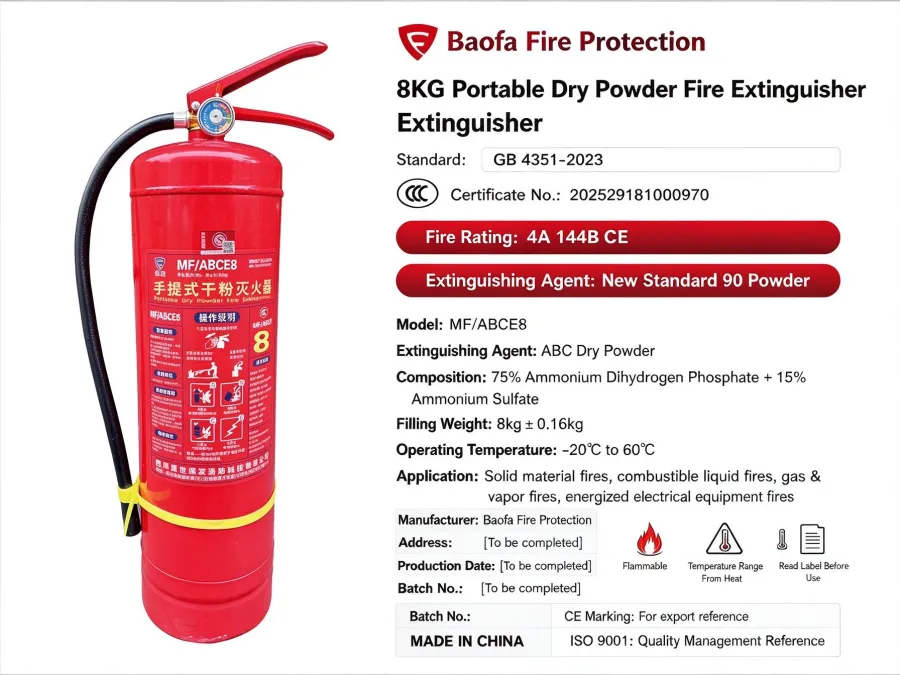
Pins and seals are usually bought alongside valves and heads rather than as standalone items. If you source complete units such as the 8kg ABC dry powder fire extinguisher, confirm that the pin and seal fitted match the specification you approved, and that spares are included. Buyers assembling locally often purchase valves, pins and seals as a matched set to avoid mismatch.
When vetting a supplier, ask for the pin drawing, seal material data and a sample of the fitted assembly. Check whether the supplier can supply the same pin and seal across the full capacity range, from 1 kg portable units up to wheeled models, so that your service network stocks one spare type. A full overview of available models is on the products page.
On commercial terms, pins and seals are low-value items and rarely drive MOQ on their own; MOQ is normally set by the parent valve or extinguisher order. Lead time for standard pins and seals is typically short, but custom seal markings or colours can add production time. Documentation should include the material specification, dimensional drawing and packing list showing the spares allowance.
Keep a single approved specification sheet per model covering pin dimensions, material, seal type, colour and marking. This sheet becomes the reference for goods-in checks, service technician training and any later claim. Where local rules require tamper-evident sealing at the point of sale, note the requirement on the same sheet so production does not default to a plain seal.
For buyers who also handle servicing, record the batch of pins and seals issued against each recharge. This makes it easier to trace a run of failed inspections back to a single component batch rather than the extinguisher itself.
Pin and seal quality is a specification discipline, not a manufacturing problem. Define the pin by valve family, require a seal that loops through both pin and valve, and add a small spares allowance to every order. Buyers who treat these two parts as controlled components rather than consumables see fewer inspection failures and fewer replacement requests. Further questions on component compatibility are answered on the FAQ page.
A missing pin means the extinguisher can be actuated accidentally and provides no evidence that it has not been operated. Most inspection protocols treat this as an immediate defect, so the unit is removed from service pending recharge or replacement, regardless of gauge reading or powder condition.
In most EN3-style designs the seal should pass through both the pin and the valve or handle so that removing the pin visibly breaks the seal. A seal looped through the pin alone can be slipped off intact, which defeats the tamper-evidence purpose and is a common inspection finding.
Generally no. Pin diameter, length and ring size are matched to a specific valve and lever geometry, so a pin from a 2kg unit may not fit a 6kg or 8kg valve. Buyers should specify pins by valve family rather than by extinguisher capacity.
Stainless steel is typically preferred where humidity or salt exposure is high, because zinc-plated steel pins can corrode at the ring or at contact points. The trade-off is cost; many buyers use plated steel for dry indoor markets and stainless for coastal or tropical destinations.
A spares allowance of roughly 1–3 % of order quantity is common in export contracts, either per carton or per order. The right figure depends on your service network and whether technicians reuse pins after recharge. Agree the allowance in writing before production.
Yes, seals are commonly customised with colour, brand marking, batch code or date. Custom marking usually adds production time and may raise the minimum order quantity for the seal itself. Approve a sample of the marked seal before mass production.
Usually not as standalone items. MOQ is normally set by the parent valve or extinguisher order, with pins and seals supplied against that quantity. If you order seals as a separate custom item, expect a separate minimum based on the marking and colour.
Confirm the pin inserts and withdraws freely, cannot be removed while the seal is intact, and that the seal breaks by hand leaving clear evidence. Check markings against the approved specification and count the spares allowance against the packing list.