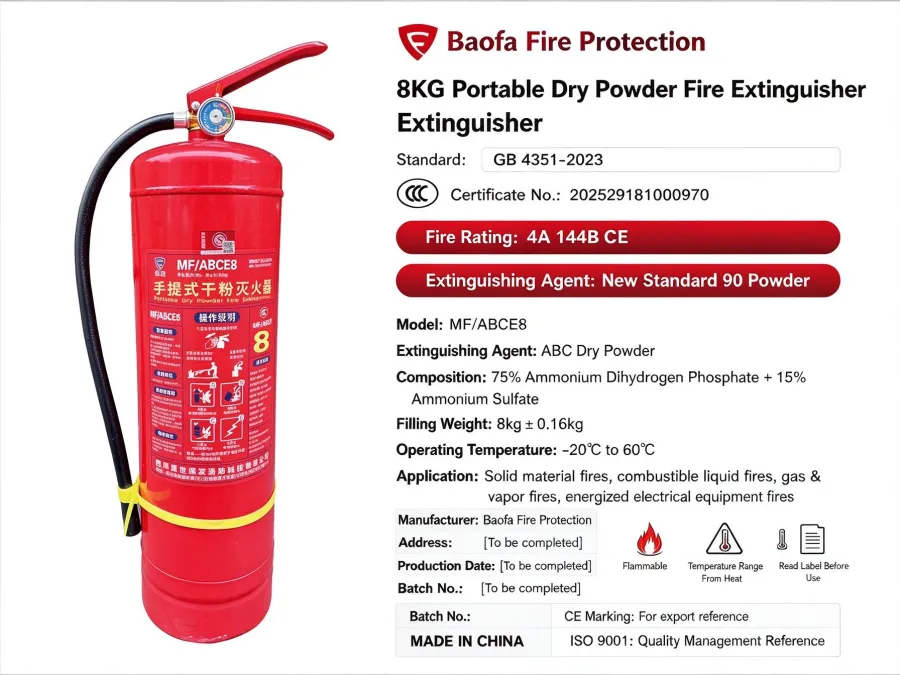
OEM private label fire extinguishers are standard production units finished with your brand: a printed body label, your carton artwork, and often a branded neck tag, manual and tamper seal. The work splits into three parts — label artwork, carton artwork and brand registration on the certificate — and each has its own approval loop. Budget several weeks between first artwork and a shippable batch, depending on how many revision rounds the label needs.
On a dry powder extinguisher, the branding surfaces are limited and each is governed by different rules. The body label carries the technical and regulatory content; the carton is commercial packaging; and the certificate listing determines whose name may appear as the legal manufacturer.
Everything else — cylinder dimensions, valve thread, gauge face, hose length — is fixed by the product design and normally cannot be changed for a private-label run. If you need different hardware, that is a separate OEM parts discussion rather than a labelling one.
A compliant extinguisher label contains mandatory content: extinguishing medium, fire class pictograms, operating instructions, service and recharge information, batch or serial number, and manufacturer details. These fields are set by the standard the unit is certified to and are checked during any factory inspection or market surveillance.
Your design freedom sits in the surrounding layout — logo placement, background colour, typography and the prominence of the model name. In most EN3 designs, the label area is roughly 90 × 130 mm to 110 × 160 mm on a portable body, but this varies with cylinder diameter and label supplier. Always request the current label template with the fixed fields marked before you start design work.
Cartons are usually the largest branding surface and the easiest to change, since they do not affect product compliance. A typical export carton for a portable unit is single-wall or double-wall corrugated, printed in one to three colours, with the unit protected by an inner divider or bag.
| Parameter | Typical range | Notes |
|---|---|---|
| Carton board | Single-wall to double-wall corrugated | Double-wall for heavier units and wheeled models |
| Print colours | 1–3 colours | Flexo print; more colours raise plate cost |
| Carton quantity | 1–4 units per carton | Depends on unit size and customer channel |
| Barcode | EAN-13 or UPC-A | Buyer-supplied; verify scan grade |
| Shipping marks | Standard export marks | Include model, quantity, gross weight |
| Pallet | Standard or custom height | Confirm container loading implications |
| Artwork lead time | Roughly 1–3 weeks | Includes proof and plate making |
Carton print plates are a one-off tooling cost. If you plan several SKUs — for example 1kg, 2kg and 4kg units — ask whether plates can be shared across sizes to reduce setup cost. See the full product range for the sizes most often combined in one private-label programme.
Whether your brand can appear as the certificate holder depends on the certification route and the notified body or test house involved. In many cases the factory remains the legal manufacturer and your brand appears as a distributor or private-label mark; in others, a separate listing is possible.
Ask for this in writing before you print anything. A label that names a certificate holder incorrectly can create problems at customs or during retail compliance checks. The FAQ section covers the documentation questions buyers raise most often.
Not every factory offers private label, and those that do differ in how much design support they provide. Ask for examples of previous label work, the number of revision rounds included, and who owns the artwork files.
MOQ for a private-label run is typically higher than for neutral stock, because label and carton printing carry setup cost. A common approach is to launch with one or two core sizes — the 8kg ABC dry powder extinguisher is frequently chosen as the lead SKU — and add sizes once the brand is established.
At shipment, a private-label order should come with the same technical file as a neutral order, plus your artwork records. Keep the approved label proof, carton proof and certificate wording on file; they are the reference point if a later batch is questioned.
Confirm before production who is responsible for checking that your label complies with the destination market's language and marking rules. This is usually a shared task, but it should be assigned explicitly rather than assumed.
Private-label extinguishers are a labelling and packaging project layered on a fixed product, so the technical fields, certificate wording and hardware stay outside your control. Start with the label template and certificate wording, then design the carton and brand elements around them. Allow time for physical proofs and confirm MOQ, plate costs and documentation before committing to a print run.
Yes, in most cases. The brand typically appears on the body label, carton and manual, while the factory remains the legal manufacturer on the certificate. Confirm the exact wording with the supplier and certification body before printing, because listing rules differ between markets and certificate routes.
Usually the factory that holds the certificate, with your company shown as distributor or private-label brand. Some routes allow a separate listing, but this depends on the notified body and is not automatic. Ask for the proposed certificate wording in writing at the quotation stage.
Supply vector files such as AI, EPS or PDF with fonts outlined, plus Pantone or CMYK colour references. Keep the mandatory pictograms and instruction block at their specified size. A physical proof on the actual label stock is strongly recommended before mass printing.
Typically one to three weeks from first draft to signed proof, depending on revision rounds and whether multi-language labels are involved. Carton plates add a few days. Build this into your order timeline rather than treating it as part of production lead time.
Yes, usually. Label and carton printing carry setup costs, so private-label MOQ per SKU is commonly higher than for neutral stock. Ask for MOQ per brand and per size, and check whether print plates can be shared across similar carton sizes to reduce tooling cost.
Generally yes. Cartons are commercial packaging and do not normally affect product compliance, provided shipping marks and barcodes are correct. The body label is different: it carries regulated content, so any change there must be checked against the certificate and applicable standard.
Expect the certificate copy, test report where applicable, declaration of conformity, packing list and commercial invoice, plus your approved label and carton proofs. Confirm the document set at order stage so nothing is missing at customs clearance.
Yes, wheeled models can be branded in the same way, with label and carton artwork applied to the chassis and packaging. Tooling and MOQ differ because volumes are usually lower, so confirm plate costs and minimum quantities separately for wheeled sizes.