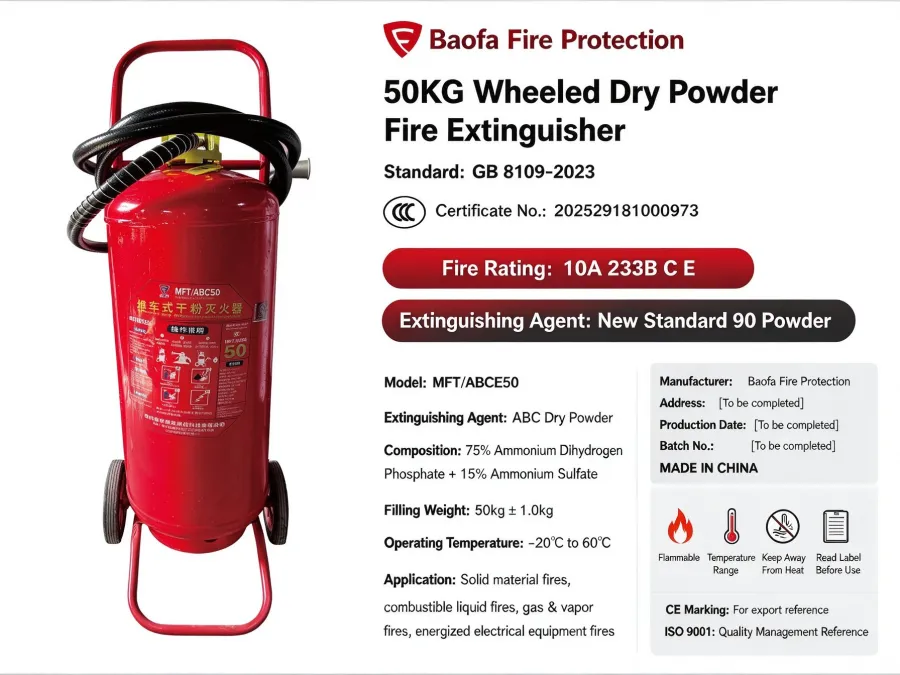
Lead times for extinguisher orders are driven by four stages: raw material and component availability, cylinder production or procurement, powder filling and assembly, and packing plus documentation. For standard catalogued portable models, total production time is typically 15–30 days after deposit and artwork approval, depending on quantity and specification. Wheeled units such as the 50kg wheeled ABC dry powder fire extinguisher and other large-capacity trolley models usually require longer because of cylinder and valve scheduling.
Not every order moves at the same speed. A repeat order of a standard 6kg portable unit in a stock bracket is faster than a first order with custom labels, non-standard valve threads or a new hose length. Buyers should separate “catalogue” items from “configured” items when requesting a schedule.
The biggest variable is usually the cylinder. If the factory runs its own cylinder line, capacity is scheduled internally; if cylinders are procured, availability depends on the supplier's own backlog. Powder filling is comparatively quick, but it comes after hydrostatic testing, drying and internal cleaning, which cannot be compressed without quality risk.
The table below shows indicative ranges for planning purposes only. Actual times depend on specification, order quantity, season and the documentation required for the destination market.
| Stage | Typical duration | Notes |
|---|---|---|
| Quotation and specification freeze | 2–7 days | Faster when drawings, label files and valve standards are confirmed |
| Artwork and label approval | 3–10 days | Multi-language labels and warning pictograms need proofing |
| Cylinder production or procurement | 10–25 days | Longest stage; depends on line capacity and size mix |
| Powder filling and assembly | 3–10 days | Follows testing, drying and cleaning |
| Pressure testing and QC sampling | 1–5 days | Batch-dependent; usually parallel with filling |
| Packing and marking | 2–7 days | Cartons, pallets, wheeled-unit crating |
| Documentation and booking | 3–10 days | Certificate of origin, packing list, dangerous goods paperwork where applicable |
Large single-model orders are usually more efficient than mixed containers. A 20ft container filled with one portable size can be scheduled in longer production runs, while a mixed load of 1kg, 2kg, 4kg, 6kg and 9kg units adds changeover time at filling and labelling. Buyers sourcing a full range can review options on the products page and then group sizes to reduce changeovers.
Wheeled extinguishers are a separate planning case. A 20kg or 50kg unit involves a larger cylinder, trolley frame, longer hose and often a different valve and gauge arrangement. These items are frequently packed on separate pallets or crated, which affects container utilisation as well as production time.
Production is only part of the timeline. Export documentation, third-party inspection bookings and certificate legalisation can add days or weeks depending on the destination. Buyers should confirm early which documents are required and whether any must be issued before shipment rather than after.
Where the buyer's market requires specific marking or notified-body involvement, the approval sequence should be agreed before the deposit. This is not a production step, but it frequently controls the shipment date. General questions on required paperwork are covered in the FAQ.
Most delays come from information gaps rather than factory capacity. The list below shows frequent errors and the practical correction.
Lead-time reliability is a supplier-selection issue as much as a scheduling issue. Ask for a production schedule with named milestones, not a single delivery date. A supplier that can explain cylinder sourcing, filling capacity and QC release steps is easier to plan around than one that only quotes a number.
Confirm MOQ per model and per label variant, since MOQ often drives whether a mixed order is economic. Ask how capacity is allocated in peak months and whether existing orders could displace yours. For OEM components, clarify whether cylinders, valves, hoses and gauges come from in-house lines or external suppliers, because each adds a dependency.
A practical calendar works backwards from the required in-store date. Subtract sea transit, port handling, documentation and QC release, then subtract production. The remaining date is the latest deposit date. Buyers who plan in this order usually avoid air freight and expediting charges.
For repeat programmes, consider a rolling forecast with a firm first order and indicative follow-on volumes. This lets the factory reserve cylinder capacity without committing the buyer to full quantities. It is particularly useful for mixed ranges that include both portable sizes and wheeled models.
In practice, a standard portable order can often be produced in 15–30 days, while wheeled and highly customised orders need longer and should be scheduled first. Confirm every date in writing against a frozen specification, and keep a buffer for holidays, inspection and shipping-space changes.
For catalogued portable models with approved artwork, production is typically 15–30 days after deposit, depending on quantity, size mix and factory backlog. Cylinder availability is usually the controlling factor. Add separate time for documentation, inspection and vessel booking before calculating the final shipment date.
Wheeled units use larger cylinders, trolley frames, longer hoses and often different valves and gauges, each with its own supply schedule. Packing and crating also take longer. Buyers should request a separate schedule for wheeled items rather than assuming they follow the portable line.
A common planning allowance is two to four weeks around major holiday periods, depending on order size and whether cylinders are produced in-house. Capacity tightens before and after the break, and transport bookings become harder. Confirm the factory's specific holiday shutdown dates before fixing a shipment window.
Yes. Large single-model runs are usually more efficient, while mixed sizes and multiple label variants add changeover time at filling and labelling. MOQ per model and per label language should be confirmed early, because consolidation can shorten the overall schedule.
Artwork should be approved before cylinders are scheduled for filling and labelling. Multi-language labels and warning pictograms need proofing time, typically several days. Late approval is one of the most common causes of missed shipment dates, even when production capacity is available.
Sometimes partially, by prioritising standard models, simplifying labels or accepting stock brackets where available. However, testing, drying and QC steps should not be compressed. Buyers should discuss options openly and expect any acceleration to be confirmed in writing rather than assumed.
Certificate of origin, packing list, commercial invoice, and any required test or conformity documents all take time to issue. Some must be completed before shipment rather than after. Confirm the full document list for your destination at the quotation stage so it is built into the schedule.
Ask for a milestone schedule rather than a single date, and request the current backlog and typical peak-season extension. Compare quoted times with the supplier's cylinder sourcing model and QC release process. Past shipment records or references, where available, help validate the claim.