Minimum order quantity (MOQ) and container loading are calculated from the same basic data: the carton dimensions and gross weight of each model, the quantity per carton, and the usable internal volume and payload of the container. In practice, most Chinese extinguisher factories set MOQ per model or per order rather than per container, so a 20ft load can often combine several capacities. The figures below are planning ranges; confirm exact values against the supplier's current packing list before booking freight.
Every loading calculation begins with the master carton. For portable extinguishers, suppliers normally pack one unit per carton for larger sizes and two to six units per carton for smaller sizes. The carton's external dimensions (in cm) and gross weight determine both the volumetric fit and the weight limit.
Ask for a packing list that states, per model: carton length × width × height, units per carton, net weight, gross weight, and whether a pallet is used. Without these five data points, any container estimate is guesswork.
Dry powder extinguishers are moderately dense. Small models are usually volume-limited (the container fills before it reaches payload), while large wheeled units are often weight-limited. Calculate both and use the lower result.
The method is the same for any model. Calculate cartons per container by volume, then check the result against the container's maximum payload.
Usable volume is typically 80–85% of nominal internal volume once pallets, loading gaps and door clearance are allowed for. A 20ft container is commonly quoted at about 28 m³ usable and a 40ft HC at about 65–68 m³ usable, depending on configuration.
| Parameter | Typical range | Notes |
|---|---|---|
| Carton, 1–2kg model | 2–6 units per carton | Small cartons, volume-limited |
| Carton, 3–6kg model | 1–4 units per carton | Depends on valve and bracket |
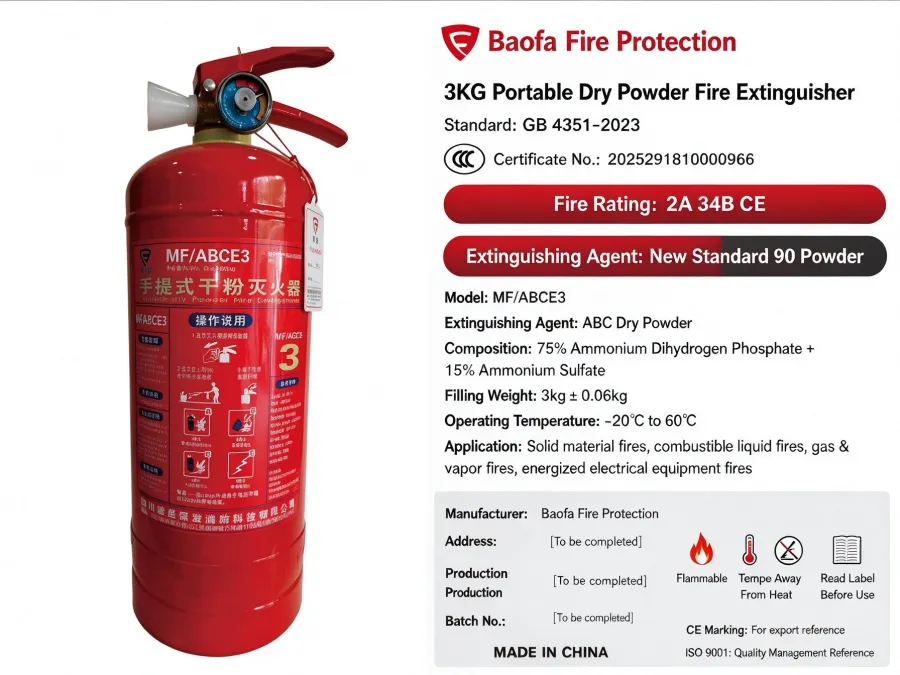
| Carton gross weight, 3kg model | approx. 5–7 kg | Varies with bracket and packaging |
| 20ft usable volume | approx. 26–28 m³ | After dunnage allowance |
| 40ft HC usable volume | approx. 65–68 m³ | Higher cube, same footprint |
| 20ft payload | approx. 17–21 t | Road limits may be lower |
| 40ft HC payload | approx. 19–26 t | Check destination road rules |
| Pallet height allowance | 100–150 mm | If palletised |
MOQ is usually expressed per model, per order, or per mixed container. A common structure is a low MOQ per model for standard sizes and a higher MOQ for non-standard colours, private-label printing or special valve configurations.
Because MOQ is per model, buyers often reach the container minimum with a mixed load rather than a single size. For example, a first order might combine 1kg, 2kg, 3kg and 4kg units to test the market while still filling one container.
Mixed loads are normal, but each additional model adds a separate carton specification and, often, a separate carton marking. Keep the number of models per container modest in early orders; four to six SKUs is usually manageable without complicating loading or documentation.
Ask each candidate supplier for a current packing list and a recent loading report for a comparable order. A supplier that cannot produce carton dimensions quickly is unlikely to manage loading documentation reliably.
Confirm MOQ in writing, including any surcharge for private label, and ask how lead time changes between a 500-unit and a full-container order. Documentation should include a packing list that matches the loaded cartons, plus test reports and certificates relevant to the destination market.
For model-specific data, review the 3kg ABC dry powder fire extinguisher page, compare capacities on the products overview, and check commercial terms in the FAQ.
Calculate loading from carton volume and gross weight, apply a usable-volume factor of 80–85%, and take the lower of the volume and weight results. Confirm whether MOQ applies per model or per order, and keep early loads mixed but simple. A written packing list and loading report from the supplier removes most disputes before shipment.
MOQ is typically set per model, per order or per mixed container. Standard sizes carry lower MOQs, while private-label printing, custom colours or non-standard valves usually require higher quantities. Always confirm in writing whether the figure applies to each model or to the total order value.
It depends on the carton configuration. With one unit per carton at roughly 5–7 kg gross, a 20ft container is usually volume-limited rather than weight-limited. Request the supplier's packing list and calculate cartons by volume, then verify against payload before booking.
Calculate both and use the lower result. Small portable models are generally volume-limited, while large wheeled units are often weight-limited. Destination road weight limits can further reduce the practical payload below the container rating.
Not automatically. The 40ft HC offers more usable volume per unit of freight cost, but only if you can sell the quantity before storage costs erode the saving. For first orders or slow-moving sizes, a 20ft or mixed load may be more economical overall.
Yes, mixed loads are common. Each model needs its own carton specification and shipping mark, so keep the number of SKUs modest on early orders. Four to six models per container is usually straightforward to load and document.
Yes. Pallets add 100–150 mm of height per layer and their tare weight counts toward payload. Floor loading generally fits more cartons, but palletising can reduce handling damage and labour at destination, so the trade-off should be decided per market.
A packing list matching the loaded cartons, commercial invoice, and any certificate of origin or test reports required by the destination market. A loading report with photos is useful evidence if carton counts or condition are later disputed.
Private labelling usually raises MOQ because cartons and labels are printed per customer. It can also change carton dimensions slightly, so request an updated packing list after artwork approval and recalculate container quantities before confirming.