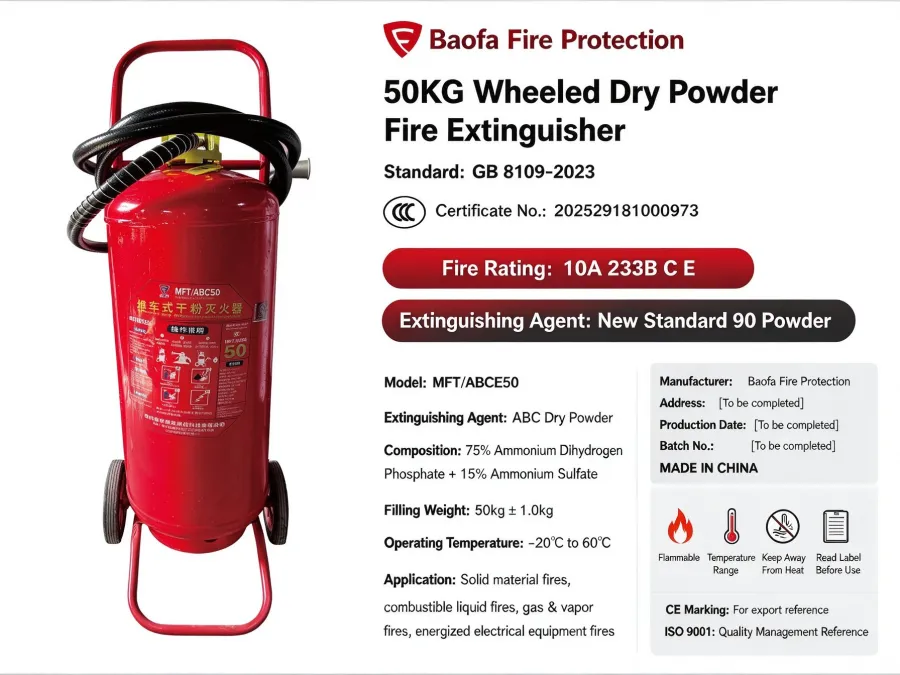
MOQ for extinguisher orders is normally set per model and per production run, while container loading is calculated from carton dimensions, gross weight and stackability rather than from extinguisher capacity alone. For most Chinese suppliers, a mixed order of portable units can start at a few hundred pieces per model, whereas wheeled units such as the 50kg wheeled ABC dry powder extinguisher are usually quoted in tens of units per batch. This guide explains how to size both numbers before you request a quotation.
Suppliers rarely apply one MOQ to a whole catalogue. It is usually defined per SKU, per cylinder size and per label or branding requirement. A standard 6kg unit with the factory's existing valve and label may have a lower MOQ than the same cylinder with a custom gauge face and printed carton.
Two MOQ figures matter to buyers. The order MOQ is the total quantity the factory will accept for a production run; the line MOQ is the minimum for each individual model inside that order. Always confirm both in writing, because a low order MOQ can still hide a high line MOQ on slow-moving sizes.
| Product group | Typical line MOQ | Typical order MOQ | Main MOQ driver |
|---|---|---|---|
| Portable 1kg–3kg | 200–500 pcs | 500–1,000 pcs | Carton printing, label runs |
| Portable 4kg–8kg | 200–500 pcs | 500–1,000 pcs | Valve batch size, powder filling |
| Wheeled 20kg | 20–50 pcs | 50–100 pcs | Hose and trolley assembly |
| Wheeled 35kg–50kg | 10–30 pcs | 30–60 pcs | Cylinder welding batch, crating |
| OEM parts (valves, gauges) | 500–2,000 pcs | 2,000–5,000 pcs | Tooling and moulding runs |
These figures are indicative only. Actual MOQ depends on specification, existing tooling and the factory's current schedule, so treat them as a planning baseline rather than a quotation.
Loading is a volume and weight problem, not a piece-count problem. Start with the packed carton dimensions and gross weight of each model, then compare the resulting CBM and total weight against the container's practical limits. A 20ft container is commonly planned at around 28 CBM usable and 20–25 tonnes payload; a 40ft high-cube at roughly 65–68 CBM, subject to carrier and road limits at destination.
Portable extinguishers are usually volume-limited, so the carton size decides the load. Wheeled extinguishers are often weight-limited or awkward to stack, so pallet footprint and crating matter more than CBM alone.
Assume a 6kg portable packs 2 units per carton at 0.045 CBM and 17kg gross. A 20ft container at 28 CBM holds about 620 cartons, or roughly 1,240 units, but the same load weighs about 10.5 tonnes, so volume is the constraint. For a 50kg wheeled unit crated at about 0.35 CBM and 78kg gross, a 20ft container reaches roughly 80 units by volume but around 280 by weight, so volume and handling govern the load.
Most importers ship a mix of sizes rather than one SKU. Build the load in layers: first the high-volume portable sizes such as 4kg and 6kg, then slower sizes, then wheeled units as the base or top layer depending on stacking rules. Keep each model in full cartons so the packing list stays simple.
Mixed loads reduce per-unit freight but raise handling time and documentation complexity. Confirm with the supplier that the loading plan is realistic and that the container will not be declared over weight at the terminal.
Ask each candidate supplier for a packing specification sheet covering carton dimensions, units per carton, gross weight, pallet pattern and CBM per 20ft and 40ft. Suppliers who cannot provide this quickly are unlikely to manage loading documentation well. Cross-check the figures against a sample shipment or a third-party inspection report.
Documentation should include the packing list, commercial invoice, certificate of origin where applicable and any test or conformity documents relevant to the destination market. Confirm Incoterms, production lead time and the booking cut-off date, since loading plans often shift when a vessel is rolled.
For a broader view of the range and how models compare, review the full product catalogue before fixing quantities, and check the FAQ for common order and shipping questions.
Set MOQ per model first, then build the container from packed carton CBM and gross weight with a 10–15% stowage allowance. Confirm every figure in writing, including stacking rules for wheeled units and destination weight limits. A simple packing spreadsheet agreed before deposit prevents most loading disputes later.
MOQ is normally set per model and per production run. Portable sizes commonly start at 200–500 pieces per model with an order MOQ of 500–1,000 pieces; wheeled 20kg–50kg units are usually quoted at 10–50 pieces per model. Actual figures depend on specification, branding and existing tooling.
Loading depends on carton size. If two 6kg units pack per carton at roughly 0.045 CBM, a 20ft container planned at about 28 CBM usable holds around 600 cartons, or about 1,200 units. Confirm carton dimensions and gross weight with the supplier before ordering.
A crated 50kg wheeled unit typically occupies around 0.3–0.4 CBM. A 40ft high-cube planned at 65–68 CBM may hold roughly 160–200 units by volume, but stacking rules and weight limits often reduce the practical count. Confirm the loading plan in writing.
Check both. Portable extinguishers are usually volume-limited, so carton CBM governs the load. Wheeled units are heavier and harder to stack, so weight and handling often govern. Always compare total gross weight against container payload and destination road limits.
Typical documents include the packing list, commercial invoice, bill of lading, certificate of origin where required and any conformity or test documents for the destination market. Confirm document requirements with your freight forwarder and the supplier before production starts.
Yes, mixed loads are common and reduce per-unit freight. Keep each model in full cartons, confirm line MOQ for each size and ask the supplier for a loading plan showing carton counts, CBM and total gross weight before deposit.
Lead time varies with quantity, branding and season. Standard models with existing labels often ship in a few weeks after deposit and artwork approval; custom labels, cartons or wheeled units usually take longer. Confirm the schedule and booking cut-off in writing.
Apply a stowage allowance of roughly 10–15% on top of the calculated carton volume. Palletised cargo, crated wheeled units and access space all reduce usable capacity, so a container filled to nominal CBM on paper will usually not load in practice.