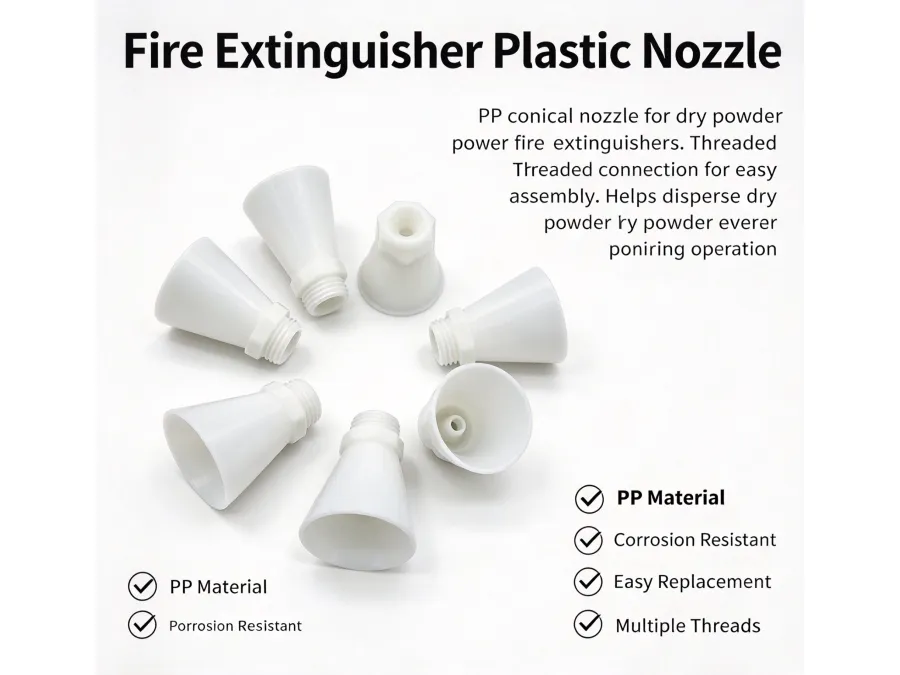
Fire extinguisher hose and nozzle specifications for OEM assembly are defined by three variables: the valve outlet thread, the extinguisher capacity, and the target market's standard (EN3, or a national variant). In most EN3-style portable designs, a 4–6 kg ABC dry powder unit uses a flexible hose of roughly 400–600 mm with a horn or nozzle matched to the valve outlet bore. Buyers assembling without powder should specify hose, horn and thread as one matched set rather than sourcing each item separately.
The discharge performance of a stored-pressure dry powder extinguisher depends on the pressure drop across the whole path: valve outlet, hose bore, and horn or nozzle geometry. A hose that is correct in length but undersized in bore will restrict flow and change discharge time and range. A horn with the wrong cone angle can scatter powder rather than form a directed stream.
For OEM plants, this means the hose and nozzle should be specified against the valve drawing, not against a generic parts list. In most designs the hose is crimped or clamped to a swivel nut that threads onto the valve outlet, and the horn or nozzle is fitted at the opposite end.
Because the assembly is pressure- and flow-critical, buyers typically keep hose, horn and valve from a single supplier or a single matched specification. Mixing sources is possible but requires a dimensional check on every batch.
Hose bore is normally expressed in millimetres and correlates with extinguisher capacity. Small portables often use a short hose or no hose at all, while 4–9 kg units use a longer flexible hose to reach the fire source safely. Wheeled units use longer, larger-bore hose assemblies.
Working pressure for stored-pressure ABC units is typically in the 12–18 bar range at 20 °C, with burst requirements set well above working pressure by the applicable standard. Buyers should request the hose's rated working and burst pressure, not just its dimensions.
| Parameter | Typical range (portable) | Typical range (wheeled) | Notes |
|---|---|---|---|
| Hose bore | 6–10 mm | 10–16 mm | Matched to valve outlet bore |
| Hose length | 300–650 mm | 600–1,200 mm | Depends on capacity and market standard |
| Working pressure | 12–18 bar | 12–18 bar | At ambient temperature |
| Hose construction | Rubber or polymer, textile reinforced | Reinforced, heavier wall | Specify if abrasion resistance matters |
| End fittings | Swivel nut + ferrule | Swivel nut + ferrule | Crimp type to be confirmed |
| Horn / nozzle material | Aluminium, brass or polymer | Aluminium or brass | Polymer common on small units |
| Horn outlet diameter | 15–30 mm | 20–40 mm | Affects discharge pattern |
| Thread standard | M24×1.5, M30×1.5 or market-specific | Market-specific | Confirm against valve drawing |
The classic powder horn is a truncated cone that widens from the hose end to the outlet. Cone angle and outlet diameter determine how the powder stream spreads. A wider outlet gives a broader cloud; a narrower outlet gives a longer, more directed stream.
Some designs use a moulded or machined nozzle rather than an open horn, particularly where a defined spray pattern or a non-metallic outlet is preferred. Nozzle bore and internal taper should be specified together with the hose bore.
For buyers assembling small portables, the horn or nozzle is often the least expensive component but the most visible to the end user. Surface finish, burr-free edges and consistent outlet diameter are the practical quality points. The extinguisher horn and nozzle range shows the common configurations available for OEM orders.
Thread mismatch is the most common cause of assembly-line rejection in OEM parts supply. Valve outlets vary by market and by manufacturer, and nominally similar threads can differ in pitch or flank angle.
Buyers should obtain a thread drawing or a physical sample and verify with a thread gauge before placing a bulk order. Where a market requires a specific outlet type, this should be stated in the purchase specification rather than agreed verbally.
It is also worth confirming whether the swivel nut is captive on the hose and whether the assembly is supplied pre-crimped or as loose components for in-house crimping.
When vetting a supplier for hose and nozzle components, ask for the dimensional drawing, the material specification and the pressure test method. A supplier who can supply these documents consistently is usually easier to audit than one who quotes from a catalogue photo.
MOQ for OEM hose and horn assemblies is commonly quoted in the hundreds to low thousands per configuration, depending on whether tooling is involved. Lead time typically runs from a few weeks for standard configurations to longer where new tooling or custom threads are required.
Documentation should include the dimensional drawing, material declaration, pressure test record and packing list. For buyers who also source complete units, the same specification logic applies across the portable range, from the 1 kg ABC extinguisher through to the 6 kg ABC extinguisher and larger wheeled models. A full overview of available parts and finished units is on the products page.
Specify hose and nozzle as a matched assembly against the valve drawing, with bore, length, pressure rating and thread all stated explicitly. Verify threads with a gauge before bulk ordering and inspect every batch for crimp quality and outlet dimensions. Treated this way, hose and horn sourcing becomes a predictable part of OEM assembly rather than a recurring quality problem.
Hose length for a 6 kg portable ABC extinguisher is typically in the 400–650 mm range, depending on the valve design and the destination market's standard. The length should be confirmed against the valve drawing and the applicable national requirement rather than assumed from a catalogue. Buyers should specify length measured end-to-end with fittings fitted.
Common valve outlet threads include M24×1.5 and M30×1.5, with other market-specific threads also in use. Nominal sizes can differ in pitch or flank angle between manufacturers, so a thread gauge check against the approved valve drawing is recommended before bulk ordering.
Yes. Hose bore, together with valve outlet size and horn geometry, affects pressure drop and therefore discharge time and range. An undersized bore can restrict flow and change performance relative to the tested configuration. Bore should be specified as part of the matched hose-horn-valve assembly.
Stored-pressure ABC portables typically operate in the 12–18 bar range at ambient temperature, with burst requirements set well above working pressure by the applicable standard. Buyers should request both working and burst pressure figures, and ask for the assembled hose test rather than material data alone.
A horn is a truncated cone that widens toward the outlet and spreads powder into a cloud. A nozzle is a shaped outlet, often moulded or machined, that can produce a more defined pattern. Both are specified by outlet diameter and internal geometry, and both must match the hose bore.
Yes. OEM component supply commonly covers hoses, horns, nozzles, valves, gauges and pins as separate items for assembly plants. Buyers should confirm that the components are supplied to a dimensional drawing and that thread compatibility with their chosen valve is verified before ordering.
MOQ is commonly quoted in the hundreds to low thousands per configuration, depending on whether custom tooling or non-standard threads are involved. Standard configurations usually carry lower minimums than custom ones. Buyers should confirm MOQ per part number rather than per order.
Check threads with a gauge, measure hose length and bore, inspect crimp ferrules for concentricity, verify horn outlet diameter, and request the pressure test record. A sample assembly fitted to a valve and function-checked before bulk release catches most compatibility issues early.