EN3 is the European product standard for portable fire extinguishers, and CE marking is the manufacturer's declaration that a unit conforms to it and to the applicable EU rules. Buyers should check the EN3 test evidence, the Declaration of Performance (DoP), the notified body involvement where required, and the marking on the finished unit before placing an order. This guide sets out what to verify on extinguishers and on components such as the fire extinguisher valve.
EN3 is a harmonised standard covering portable fire extinguishers. It defines performance requirements and test methods, including fire test ratings, pressure resistance, discharge performance and durability of components. A unit that passes EN3 testing can be presumed to meet the essential requirements it covers.
CE marking is not a certificate issued by the EU. It is a manufacturer's declaration of conformity, supported by technical documentation and, where the applicable directive or regulation requires it, by assessment involving a notified body. For extinguishers, the relevant framework is usually the Pressure Equipment Directive (PED) for the cylinder and pressure-bearing parts, alongside EN3 for product performance.
In practice, buyers should treat "CE" and "EN3" as two separate checks: one on the pressure equipment and one on the extinguisher as a finished product. A supplier who can explain both, with documents, is easier to audit than one who only offers a logo on a brochure.
Ask for a document pack, not a single certificate image. The pack should be traceable to the exact model, size and production site you intend to buy. Where a document refers to a different model number or factory, ask for the correct version.
For OEM buyers assembling units locally, the component documents matter as much as the finished-unit file. Valve conformity evidence, for example, should match the valve model you actually order. A general catalogue page is not a substitute.
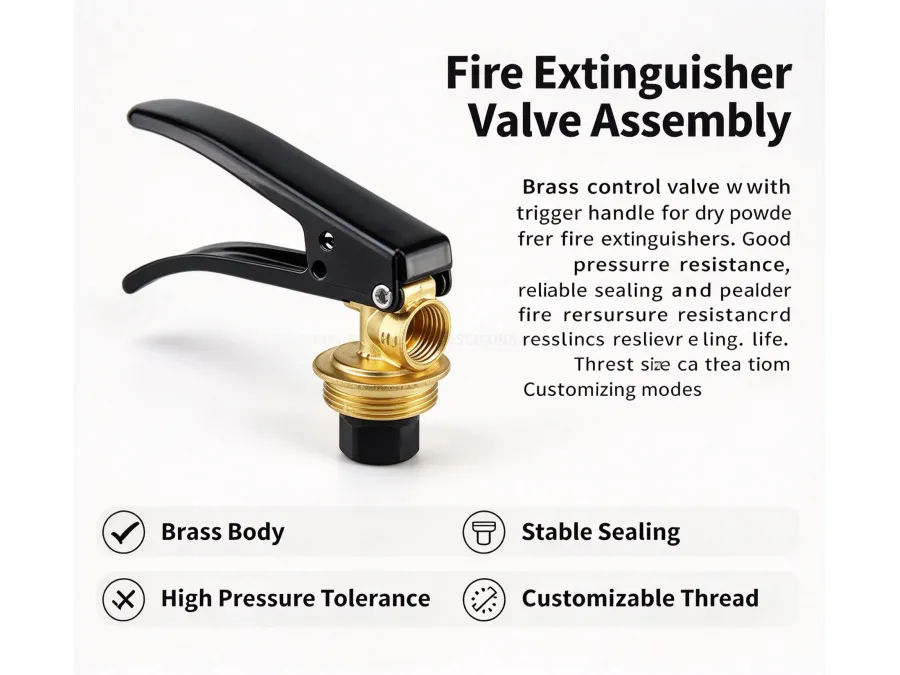
The valve is a pressure-bearing component and a frequent weak point in documentation. Check that the valve model in the order matches the model referenced in the test and conformity documents. Verify the working pressure range, thread standards and the presence of a pressure relief or safety device where the design requires one.
Details worth confirming in writing include body material, inlet and outlet thread type, dip tube length for the cylinder size, and gauge port specification. These details affect both conformity and assembly fit. Our extinguisher valve page lists the configurable options; confirm the exact variant against your documentation before ordering.
The table below shows typical ranges and where they appear in documentation. Values vary by model and by the standard version applied, so treat them as a checklist rather than fixed figures.
| Item | Typical range / option | Where to verify |
|---|---|---|
| Portable capacity | 1 kg to 12 kg (larger sizes as wheeled units) | DoP and model list |
| Fire rating | Class A and B ratings vary by size, e.g. 8A–34A, 34B–233B | EN3 test report |
| Working pressure | Typically 12–18 bar at 20 °C, depending on design | Cylinder and valve documents |
| Test pressure | Above working pressure, per the applied standard | Pressure test record |
| Body material | Steel or aluminium | Cylinder certificate |
| Valve thread | M24×1.5, M30×1.5 and other options | Valve drawing |
| Operating temperature | Typically −20 °C to +60 °C for stored-pressure units | Label and manual |
| Marking | CE mark, pressure, capacity, rating, manufacturer | Label artwork |
Vet the production site, not only the trading company. Ask which factory performs cylinder forming, powder filling and final assembly, and request the document pack for that site. A short video audit or third-party inspection before shipment is a practical middle ground. Our product range shows the models and component categories typically available for OEM programmes.
MOQ and lead time depend on whether you buy finished units or components. Finished extinguishers are often quoted in pallet or container quantities, while valves and spare parts may have lower minimums. Lead times typically run from a few weeks for standard items to longer for custom marking or non-standard valve variants. Confirm both in the quotation, together with the document pack delivery date.
Ask how documents are version-controlled. If a standard or directive is updated, you want to know which production batches carry which document revision. This matters for tenders and for ongoing distributor compliance.
On arrival, check marking against the approved artwork, confirm the pressure gauge reading, and inspect the safety pin and tamper seal. Sample-check valve operation and hose fit. Keep the document pack with the shipment records so it can be produced for tenders or market surveillance.
For recurring orders, re-confirm documents at each renewal cycle and after any design change. Buyers with questions on documentation scope can review our FAQ or request the current document list for a specific model.
EN3 and CE checks are a documentation exercise as much as a product one: match the model, the factory and the component variant to the evidence provided. Request a complete, model-specific document pack before ordering, and verify marking on a sample. This keeps distributor and OEM programmes predictable across repeat shipments.
EN3 is the European product standard defining performance and test methods for portable fire extinguishers. CE marking is the manufacturer's declaration that the product conforms to applicable EU legislation, supported by technical documentation and, where required, notified body assessment. Buyers should verify both separately rather than treating the CE logo as proof of EN3 testing.
Request a model-specific pack: EU Declaration of Conformity or DoP, EN3 test reports showing fire ratings, PED-related cylinder documentation, pressure test records, component conformity evidence for valves and hoses, label artwork and the instruction manual in the destination language. Each document should name the exact model, size and production site.
Yes, in most cases. The valve is a pressure-bearing component, so its documentation should match the model you order, including working pressure, thread type and material. If the valve variant differs from the documented model, conformity evidence may not apply to your shipment, which is a common finding in audits.
Ask for the EN3 test report covering that model and size, and check the A and B class ratings stated. Ratings vary by capacity, so a 1 kg unit and a 6 kg unit will not carry the same figures. Compare the rating on the label artwork with the test report before approving production.
CE marking indicates conformity with the applicable EU legislation, typically including the Pressure Equipment Directive for the cylinder and pressure-bearing parts. It does not by itself prove EN3 fire performance. Buyers should confirm both the pressure equipment documentation and the EN3 test evidence for the finished product.
Yes. Many assembly plants buy cylinders, valves, hoses, gauges and safety pins separately and fill powder locally. In that case, confirm component conformity documents, thread compatibility and dip tube length for your cylinder, and agree who holds the finished-product declaration of conformity.
Timing varies. Standard models with existing documentation are usually supplied with the quotation or within a few days. Custom marking, non-standard valve variants or new models may require longer. Agree the document delivery date in the purchase order so it does not delay shipment.
Check marking against approved artwork, confirm gauge readings, and inspect safety pins and tamper seals. Sample-check valve operation and hose fit. File the document pack with shipment records for tenders or market surveillance, and re-confirm documents after any design change or renewal cycle.