Dry powder refill and maintenance is the recurring revenue stream that turns a one-off extinguisher sale into a long-term service relationship. For distributors, the practical questions are how often units must be serviced, what powder and spare parts to stock, and how to keep refill work compliant with the local rules of each market. This guide covers those points with ranges rather than fixed figures, because intervals and requirements vary by country, by authority having jurisdiction and by the original manufacturer's instructions.
An extinguisher is a pressure vessel with a finite service life between interventions. Powder can compact, moisture can enter, and the propellant charge can be lost through slow leaks. Regular inspection and periodic refill keep a distributor's installed base usable and create predictable parts demand for valves, hoses, gauges and safety pins.
Servicing also protects the distributor commercially. A documented maintenance record supports the end user during fire-safety inspections, and it gives the distributor a reason to stay in contact with the account between new-equipment orders.
Buyers often use "maintenance" and "refill" interchangeably, but they are different activities with different intervals. Inspection is a visual and functional check; refill is a workshop operation that opens the unit, replaces the powder and recharges it.
Always confirm the applicable interval against the local standard and the extinguisher's own label. Where the two differ, the stricter requirement normally governs.
ABC dry powder is a mix of monoammonium phosphate and additives. It is not a single commodity: particle size, flow agent, moisture resistance and colour vary between producers. Mixing powders from different sources in one cylinder is poor practice because flow and extinguishing behaviour can change.
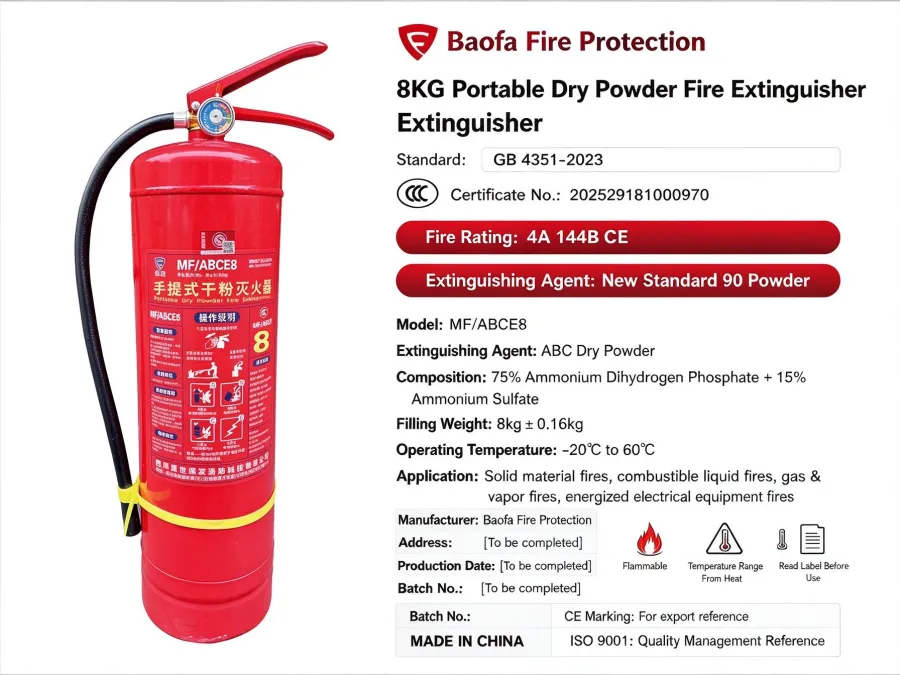
For refill stock, choose a powder grade that matches the original fill specification of the extinguishers you sell. If you distribute an 8kg ABC unit such as the 8kg ABC dry powder fire extinguisher, keep a matching refill grade so that serviced units retain their original performance characteristics.
| Parameter | Typical range | Notes |
|---|---|---|
| Refill powder mass (portable) | 1 kg – 9 kg | Matches nominal capacity plus tolerance |
| Refill powder mass (wheeled) | 20 kg – 50 kg | Larger units need bulk powder handling |
| Powder moisture content | ≤ 0.25 % – 0.5 % | Depends on specification; verify with supplier |
| Propellant | Nitrogen, 12 – 15 bar | Stored-pressure designs; confirm on label |
| Refill interval | 5 – 6 years | Local rules may require shorter |
| Hydrostatic test interval | 5 – 10 years | Varies by cylinder material and market |
| Workshop throughput | 10 – 40 units/day | Depends on staffing and equipment |
A basic refill station needs a filling bench, a calibrated scale, a nitrogen regulator and hose, a powder recovery or extraction system, and a supply of service parts. Ventilation and dust control matter: fine powder is unpleasant and can be hazardous in enclosed spaces.
Service parts are the hidden cost of a refill programme. Valves, O-rings, hoses, nozzles, gauges and safety pins are consumed at every intervention. Distributors who buy these as OEM components alongside finished units usually achieve better cost control than those sourcing them ad hoc.
Refill economics are driven by powder cost, labour time, service parts and the number of units processed per batch. Small portables take proportionally more labour per kilogram of powder than wheeled units, so per-unit pricing usually favours larger cylinders.
For distributors, the sensible model is to price refill as a service with parts included, and to keep a separate line for replacement components. This makes margin visible and avoids the common situation where service work is subsidised by new-equipment sales.
When sourcing refill powder or OEM service components, ask for the specification sheet, batch consistency data and packaging details. Powder is usually supplied in sealed bags or drums; confirm net weight, pallet configuration and shelf life before ordering.
For finished units and components, review the full range at our products to compare capacities and parts. A mixed order of finished extinguishers and service components often improves freight utilisation.
Lead times for powder and parts are typically shorter than for finished extinguishers, but they still depend on grade and order size. Plan refill stock ahead of peak inspection seasons in your market.
Traceability is increasingly requested by end users and auditors. At minimum, keep a record linking each serviced unit to the powder batch, the parts used and the technician. This supports warranty discussions and helps identify affected units if a batch issue arises.
For background on intervals and compliance questions buyers raise most often, see our FAQ.
Refill and maintenance is a disciplined workshop activity, not an informal top-up service. Distributors who standardise powder grade, service parts and record-keeping gain a reliable recurring revenue line alongside new-equipment sales. Start by matching your refill stock to the extinguisher models you already distribute, then confirm each market's interval requirements before quoting service contracts.
Powder replacement is typically carried out every 5–6 years, depending on specification and local regulation. Annual servicing and monthly user checks sit between refills. Always confirm the interval against the local standard and the extinguisher's own label, and apply the stricter requirement where the two differ.
No. Partial top-ups mix powders of different origin and leave uncertain fill weight. The correct procedure is to discharge, open the unit, inspect the interior and valve, then refill with a single documented powder grade to the specified weight.
Most stored-pressure ABC units are charged with dry nitrogen, commonly in the 12–15 bar range depending on design. The exact figure is stated on the unit label and in the manufacturer's instructions. Air should not be used because of moisture content.
Typical stock includes valve heads or valve internals, O-rings, hoses, nozzles, pressure gauges, safety pins and tamper seals. Consumption rates depend on the models you service. Buying these as OEM components alongside finished extinguishers usually gives better cost control than ad hoc sourcing.
It should. Particle size, flow agent and moisture resistance vary between producers, and mixing sources can change flow and extinguishing behaviour. Ask your supplier for the powder specification and batch records so serviced units retain their original performance characteristics.
Request a packing list, certificate of origin and safety data sheet as a minimum, plus batch records linking powder to production. For service work, keep internal records of powder batch, fill weight, charge pressure and technician for each unit serviced.
The principle is the same, but wheeled units such as 20–50 kg models need bulk powder handling, larger scales and longer hose runs. Throughput per unit is lower and labour per kilogram is higher, so pricing should reflect the difference.
Servicing covers inspection, powder replacement and recharging. Hydrostatic testing is a pressure test of the cylinder itself, typically at 5–10 year intervals depending on cylinder material and jurisdiction. The two are separate operations with separate records.